Last night, Jonathan Ross had a special report on Film 2006 about a few notable British films that will be cropping up at a cineplex near you (or at the London Film Festival now if you're keen). They seem like interesting, funny and engaging stories worthy of our attention so put aside any cynicism and sour grapes, and support British film.
Let's have a look:
Scenes of a Sexual Nature: A low-to-no-budget ensemble drama starring the cream of British talent. Kudos to the filmmakers for getting it made and attracting such a high-profile cast.
Hot Fuzz: Simon Pegg & Edgar Wright look set to do the cop movie what they did to zombies. The trailer where Simon Pegg somersaults over a garden fence is great.
Borat: Sacha Baron-Cohen's profile and popularity rises with his disingenuous spoof of an innocent simpleton from Kazakhstan.
The Last King of Scotland: I had to a trial report of this script for Film4 in 1999 in order to convince them to let me be one of their readers. As a green and keen reader, it was a tricky script to critique but a very engaging and interesting story nonetheless.
Starter for Ten: David Nicholl's adaptation of his own book about romance, education, 80s fashion and University Challenge. Charming and funny, and a very well-written script.
Sixty Six: Paul Weiland tells an autobiographical tale of a boy's Bar Mitzvah clashing with England's game in the World Cup Final of 1966.
Red Road: Andrea Arnold's directorial debut after her Oscar-winning short film success of last year, Wasp.
Night People: Writer/director (and friend of the blog), Adrian Mead, sees his directorial debut released in Scotland this week so go along to support it if you can at the Filmhouse Edinburgh, Cineworld Edinburgh or check it out in GLASGOW from Sun 5th Nov - Tues 7th Nov at the Glasgow Film Theatre (GFT). See a trailer for Night People and more info at Mead Kerr's website.
And a bit of Irish news. A huge shout out and congratulations to writer/director Tom Cosgrove for winning the Final Draft Big Break Competition with his script 'The Sea Devils' (from over 3,000 entrants).
Selasa, 31 Oktober 2006

Jumat, 27 Oktober 2006
Script Reading Tips
I’ve spoken about script reports before, and how they are laid out and what the exec would expect to read in terms of the script’s critique. Once you start reading for a few different companies, they sometimes give you their own criteria on how they like their reports, and what they expect to read. It’s all variations of the main topics, of course, but they’re usually good script reading tips nonetheless. And it’s always good to revise, and be aware, so here are some useful reminders of how your script is being assessed once it gets sent out.
---
Quality of Concept: Is it an original premise? Is it a genre? Is it fulfilling its genre requirements in an interesting and engaging way? Is it a script with commercial or cultural potential, or does it have a specific target audience that would still make it worthwhile?
Story: What is the strength of the central concept and is it clearly established/dramatised in the story? What is the strength and clarity of the narrative and its development? Is the plotting overly-contrived or convenient, or does it feel organic and dramatic to the characters and story? Are the sub-plots noteworthy or indeed noticeable?
Structure: Does the script move at a good pace and utilise a fitting structure to tell its story? Are there discernable act-breaks or turning points? Does the action and story build appropriate interest and momentum to achieve these turning points? Is it too predictable or does it defy expectation?
Characterisation: Are they original characters with interesting qualities and personalities? What’s the dialogue like? Is there an emotional journey or character arc for the protagonist, and/or secondary characters?
Themes: Is there a solid coherence/integration of the theme within the body of the piece? Does it reflect social and topical issues or something more broad and universal?
Tone & Style: Is the writing consistent and skilled in its dramatic depiction? Is it too plain and drab with no real flair and voice, or does it show innovation and originality with its storytelling technique? Is there humour? What’s the atmosphere/mood like, does it change, dip, or slip into any kind of inconsistency?
Vision: What’s the visual potential of the story? Is it really TV? Does it or could it involve any technological aspects that would make the visual story more appealing?
---
These headings and questions are guidelines for the reader to think about, not for him/her to sit down and respond to each one in kind. Most of the time, readers respond on instinct and their developing insight into the whole screenwriting process so a well-written report that covers concept, structure and characters could well be more useful for the exec (and writer) than a routine checklist of every screenwriting element known to man.
---
Quality of Concept: Is it an original premise? Is it a genre? Is it fulfilling its genre requirements in an interesting and engaging way? Is it a script with commercial or cultural potential, or does it have a specific target audience that would still make it worthwhile?
Story: What is the strength of the central concept and is it clearly established/dramatised in the story? What is the strength and clarity of the narrative and its development? Is the plotting overly-contrived or convenient, or does it feel organic and dramatic to the characters and story? Are the sub-plots noteworthy or indeed noticeable?
Structure: Does the script move at a good pace and utilise a fitting structure to tell its story? Are there discernable act-breaks or turning points? Does the action and story build appropriate interest and momentum to achieve these turning points? Is it too predictable or does it defy expectation?
Characterisation: Are they original characters with interesting qualities and personalities? What’s the dialogue like? Is there an emotional journey or character arc for the protagonist, and/or secondary characters?
Themes: Is there a solid coherence/integration of the theme within the body of the piece? Does it reflect social and topical issues or something more broad and universal?
Tone & Style: Is the writing consistent and skilled in its dramatic depiction? Is it too plain and drab with no real flair and voice, or does it show innovation and originality with its storytelling technique? Is there humour? What’s the atmosphere/mood like, does it change, dip, or slip into any kind of inconsistency?
Vision: What’s the visual potential of the story? Is it really TV? Does it or could it involve any technological aspects that would make the visual story more appealing?
---
These headings and questions are guidelines for the reader to think about, not for him/her to sit down and respond to each one in kind. Most of the time, readers respond on instinct and their developing insight into the whole screenwriting process so a well-written report that covers concept, structure and characters could well be more useful for the exec (and writer) than a routine checklist of every screenwriting element known to man.
Rabu, 25 Oktober 2006
Nomination News
The uber-talented Chris Shepherd has been nominated (or is shortlisted?) for the Turner Classic Shorts Award 2006 (can't find a link) with his first live action short film, Silence is Golden. Chris has been an award-winning animator for donkeys, and has made some stonking films, more notably Dad's Dead, which was more a phenomenon than a short film. His star continues to rise, he works bloody hard and he's a great bloke to boot. Way to go Chris! In fact, Chris has also been nominated for a British Independent Film Award for his animation short (with David Shrigley), Who I Am and What I Want. There's no stopping him. Edgy, visual, energetic, interesting, compelling.
And news just in: The Amazing Adrenalinis has been nominated for a Children's BAFTA (Best Animation). That's very exciting so a discreet shout out to the creators Mark Huckerby, Nick Ostler and Dan Chambers, and Pesky Films for producing, and to all the writers (ahem, one of them being me). So a big Yahzaa! to everyone. Best of luck on the 26th November when the winner is announced.
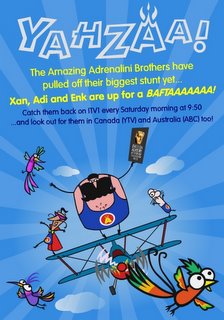
And news just in: The Amazing Adrenalinis has been nominated for a Children's BAFTA (Best Animation). That's very exciting so a discreet shout out to the creators Mark Huckerby, Nick Ostler and Dan Chambers, and Pesky Films for producing, and to all the writers (ahem, one of them being me). So a big Yahzaa! to everyone. Best of luck on the 26th November when the winner is announced.

Senin, 23 Oktober 2006
Beta Get on With It
**Updated Post**
Well, now. I wasn't go to say anything. I was just going to silently upgrade like a sleek blogger in the night. Leave you with a fresh new look without cause or explanation. And just get on with things.
But no. A few complaints, and a few compliments. Opinion divided. Put it to a vote you say. Ok then, have a go, just click'n'choose with the poll on the right. Well, there was a voting thing on the right but a glitch occurred somewhere, and it wasn't appearing, or something, so I took it down. Hmmm, maybe Beta not so great after all.
However, popular opinion seemed to heavily favour the new Beta version so ppppsssboo! to you, Sam and Berni, and the other solitary person who preferred the old look.
Meetings in London went well. Lots of chat and hot-air but also one or two things to work on immediately that will actually pay (although how quickly the contract and cash will come through is another matter entirely; long after you've done the work probably). And Doctors should be having a commissioning meeting around about now and my script editor is trying to squeeze at least one of my banked ideas through, so like, you never know. It's almost November already. Yikes.
Well, now. I wasn't go to say anything. I was just going to silently upgrade like a sleek blogger in the night. Leave you with a fresh new look without cause or explanation. And just get on with things.
But no. A few complaints, and a few compliments. Opinion divided. Put it to a vote you say. Ok then, have a go, just click'n'choose with the poll on the right. Well, there was a voting thing on the right but a glitch occurred somewhere, and it wasn't appearing, or something, so I took it down. Hmmm, maybe Beta not so great after all.
However, popular opinion seemed to heavily favour the new Beta version so ppppsssboo! to you, Sam and Berni, and the other solitary person who preferred the old look.
Meetings in London went well. Lots of chat and hot-air but also one or two things to work on immediately that will actually pay (although how quickly the contract and cash will come through is another matter entirely; long after you've done the work probably). And Doctors should be having a commissioning meeting around about now and my script editor is trying to squeeze at least one of my banked ideas through, so like, you never know. It's almost November already. Yikes.
Jumat, 20 Oktober 2006
Surprising Characterisation
So, we’ve already spoken about characters being the most important part of your screenplay. We’ve even discussed how you describe them, had a few thoughts on how to explore their multi-dimensional qualities, establish their dramatic need, and hey, even those saddo passive protagonists got a mention.
Bored with character? Not a chance. Today, let’s chat about finding original and surprising facets of characterisation that help define a person with their interests and personality.
No matter where you go, no matter who you meet, people will always surprise you. A quick glance, handshake and some polite conversation will usually provide us with a one-dimensional portrait of who the person is and what he’s like. However, once you get to know them a little bit better, you discover interesting snippets of personal information that indicate their true tastes and interests which helps to fully-define their unique personality. These traits could have their roots in deeper emotional issues: a traumatic experience from their school days, overcoming a difficult illness or constantly being dumped by girlfriends, and so on.
Real people, despite how mundane and ordinary they may appear, often have interesting and fascinating depths to their character. And so it’s somewhat surprising, and always disappointing, that fictional characters in spec screenplays do not possess these attractive quirks. Far too often in scripts, the characters are one or two-dimensional characters who only exist to serve the plot or fill a role of expectancy. In some respects, this is fine - you want the hero to be the good guy - but that doesn’t mean that they have to behave like ‘cookie-cutter’ copies of everything we’ve seen before.
The reader is looking for something - anything - to make them more interested in a character. Typically, in the first thirty pages of an ordinary script, a reader knows exactly what’s going to happen because the characters are so predictable and cliché, and they behave accordingly throughout. Here’s the tip: think of your characters as real people. You don’t have to go to exhaustive lengths of backstory and biography, just flesh them out a bit more so you know what they like or what they get up to behind closed doors. It could lead to some pleasantly surprising revelations of character that could heavily influence your story.
Real life examples: Wayne Rooney. The big grunt of a Liverpool lad who plays for Manchester United and England. Amazing talent on the pitch, questionable grooming off it, and typical working-class eloquence in TV interviews. You look at him and you think: great footballer but he’s a moron. Recently, he revealed that he has a soft spot for Oliver! The Musical. He can sing every word and his favourite song is ‘Who Will Buy?’ Eh? Come again? You can’t make that up?! That’s amazing. And you look at him in a whole new light. The big brute is a sensitive sod after all, for crying out loud.
Delia Smith. The prissy Middle-England cook who famously taught the country how to boil an egg. Her defining obsession in life? Not cooking, no sir. Football. So much so that she’s joint major shareholder in Norwich Football Club, the team she supports. And last year, to her credit and embarrassment, she stepped out on to the pitch at half time, picked up a microphone and berated the crowd for their lack of support: “Where are you? Where are you??” she cried, the second call tailing off like a drunken grandmother. And you look at her in a whole new light. She’s a passionate and emotive businesswoman, by jiminy.
What can you say about your characters? Have they any such original and surprising facets of characterisation that would help define them as human-beings, and perhaps have dramatic value within the context of the story. Yes they do. Of course they do. But you may not know it yet. Get to know them a bit better and they’ll reveal stuff you never would have believed.
Bored with character? Not a chance. Today, let’s chat about finding original and surprising facets of characterisation that help define a person with their interests and personality.
No matter where you go, no matter who you meet, people will always surprise you. A quick glance, handshake and some polite conversation will usually provide us with a one-dimensional portrait of who the person is and what he’s like. However, once you get to know them a little bit better, you discover interesting snippets of personal information that indicate their true tastes and interests which helps to fully-define their unique personality. These traits could have their roots in deeper emotional issues: a traumatic experience from their school days, overcoming a difficult illness or constantly being dumped by girlfriends, and so on.
Real people, despite how mundane and ordinary they may appear, often have interesting and fascinating depths to their character. And so it’s somewhat surprising, and always disappointing, that fictional characters in spec screenplays do not possess these attractive quirks. Far too often in scripts, the characters are one or two-dimensional characters who only exist to serve the plot or fill a role of expectancy. In some respects, this is fine - you want the hero to be the good guy - but that doesn’t mean that they have to behave like ‘cookie-cutter’ copies of everything we’ve seen before.
The reader is looking for something - anything - to make them more interested in a character. Typically, in the first thirty pages of an ordinary script, a reader knows exactly what’s going to happen because the characters are so predictable and cliché, and they behave accordingly throughout. Here’s the tip: think of your characters as real people. You don’t have to go to exhaustive lengths of backstory and biography, just flesh them out a bit more so you know what they like or what they get up to behind closed doors. It could lead to some pleasantly surprising revelations of character that could heavily influence your story.
Real life examples: Wayne Rooney. The big grunt of a Liverpool lad who plays for Manchester United and England. Amazing talent on the pitch, questionable grooming off it, and typical working-class eloquence in TV interviews. You look at him and you think: great footballer but he’s a moron. Recently, he revealed that he has a soft spot for Oliver! The Musical. He can sing every word and his favourite song is ‘Who Will Buy?’ Eh? Come again? You can’t make that up?! That’s amazing. And you look at him in a whole new light. The big brute is a sensitive sod after all, for crying out loud.
Delia Smith. The prissy Middle-England cook who famously taught the country how to boil an egg. Her defining obsession in life? Not cooking, no sir. Football. So much so that she’s joint major shareholder in Norwich Football Club, the team she supports. And last year, to her credit and embarrassment, she stepped out on to the pitch at half time, picked up a microphone and berated the crowd for their lack of support: “Where are you? Where are you??” she cried, the second call tailing off like a drunken grandmother. And you look at her in a whole new light. She’s a passionate and emotive businesswoman, by jiminy.
What can you say about your characters? Have they any such original and surprising facets of characterisation that would help define them as human-beings, and perhaps have dramatic value within the context of the story. Yes they do. Of course they do. But you may not know it yet. Get to know them a bit better and they’ll reveal stuff you never would have believed.
Selasa, 17 Oktober 2006
The First Time
I’m off to Dublin for a couple of days. Here’s a meme about ‘do you remember the first time…?’ that I can tag and bother you with until I return.
Do you remember the time…
…you became aware of scriptwriting?
Around the mid-80s when I read William Goldman’s book, Magic. The film adaptation was then on TV and I couldn’t believe that it was not a word-for-word rendition of the book. I was intrigued, and immediately hooked.
…you made the decision to give it a go?
I was always interested in writing and every time I came out of the cinema, I somehow felt I had the talent to do a better job than the bad films, and a great job of the decent ones. So I started to write a few short scripts in 1991.
…you bought your first scriptwriting ‘How To’ book?
1992. Writing Screenplays That Sell by Michael Hauge. Despite its unashamedly commercial angle, it’s got useful advice and I still refer to it to this day.
…you wrote your first script?
I was working in Bruce College in Dublin in 1992, as a Student Supervisor of all things (Colin Farrell was one of the students auditioning for Boyzone at the time), and I used the office’s typewriter to bash out my first script, The Good Guys, which was fairly tame but had some fun moments and led to an option almost ten years later when I told a producer what I’d do to make it better.
…you gave up the day job?
I gave up my cushy Channel 4 job in 1999 to follow my writing dream, sidestepping it for a few months by working on Black Books (series 1) and being Ali G’s researcher for a while. Then, I realised I had to get serious so it was total immersion in script reading and scriptwriting from about 2000 to the present day.
…you became a script reader?
I did some sitcom reading for Channel 4 when I left my job there in 1999, and then I asked Film4 if I could read some of their scripts, which led to me knocking on Tiger Aspect Pictures’ door and I got lucky. They became my sole provider until I needed to broaden my earnings and contacts, and I started to read for Working Title and others.
…you did your first proper rewrite?
Oh God. Not until 2001/2 with the rewrite of The Good Guys. A “page one” overhaul. A very good lesson and exercise nonetheless.
…you got paid for it?
Let’s see. The first time I got paid to write was when I received £300 to do a treatment of a modern day version of The Canterville Ghost. The option/rewrite on The Good Guys came after it, I think, around 2002.
…you got your agent?
In 2003. I figured I had written enough good scripts to get an agent, and I had. Micheline Steinberg stepped forward and led me to my first commission on Doctors.
…you got your first TV gig?
I pitched Doctors two ideas and after about three months, they responded and said ‘yes’ to one of them. I jumped up and down in complete elation, cried for ten minutes, and then washed the kitchen floor.
…you saw your first on-screen credit?
Sitting at home by myself watching my first episode of Doctors in February this year (3 years from idea accepted to the screen, yikes!). I pumped my fists in triumph. No tears this time.
…you made your first short film?
In the summer of last year, I wrote and directed a 3 min, no-budget short. I knew it was better to have something made, something you could show to people (and hopefully was good) instead of being ‘just another wannabe writer’. You can watch the short on YouTube here.
…you got your first cinema release?
Still working on that one.
Feel free to amend some of the questions to your own particular writing.
Do you remember the time…
…you became aware of scriptwriting?
Around the mid-80s when I read William Goldman’s book, Magic. The film adaptation was then on TV and I couldn’t believe that it was not a word-for-word rendition of the book. I was intrigued, and immediately hooked.
…you made the decision to give it a go?
I was always interested in writing and every time I came out of the cinema, I somehow felt I had the talent to do a better job than the bad films, and a great job of the decent ones. So I started to write a few short scripts in 1991.
…you bought your first scriptwriting ‘How To’ book?
1992. Writing Screenplays That Sell by Michael Hauge. Despite its unashamedly commercial angle, it’s got useful advice and I still refer to it to this day.
…you wrote your first script?
I was working in Bruce College in Dublin in 1992, as a Student Supervisor of all things (Colin Farrell was one of the students auditioning for Boyzone at the time), and I used the office’s typewriter to bash out my first script, The Good Guys, which was fairly tame but had some fun moments and led to an option almost ten years later when I told a producer what I’d do to make it better.
…you gave up the day job?
I gave up my cushy Channel 4 job in 1999 to follow my writing dream, sidestepping it for a few months by working on Black Books (series 1) and being Ali G’s researcher for a while. Then, I realised I had to get serious so it was total immersion in script reading and scriptwriting from about 2000 to the present day.
…you became a script reader?
I did some sitcom reading for Channel 4 when I left my job there in 1999, and then I asked Film4 if I could read some of their scripts, which led to me knocking on Tiger Aspect Pictures’ door and I got lucky. They became my sole provider until I needed to broaden my earnings and contacts, and I started to read for Working Title and others.
…you did your first proper rewrite?
Oh God. Not until 2001/2 with the rewrite of The Good Guys. A “page one” overhaul. A very good lesson and exercise nonetheless.
…you got paid for it?
Let’s see. The first time I got paid to write was when I received £300 to do a treatment of a modern day version of The Canterville Ghost. The option/rewrite on The Good Guys came after it, I think, around 2002.
…you got your agent?
In 2003. I figured I had written enough good scripts to get an agent, and I had. Micheline Steinberg stepped forward and led me to my first commission on Doctors.
…you got your first TV gig?
I pitched Doctors two ideas and after about three months, they responded and said ‘yes’ to one of them. I jumped up and down in complete elation, cried for ten minutes, and then washed the kitchen floor.
…you saw your first on-screen credit?
Sitting at home by myself watching my first episode of Doctors in February this year (3 years from idea accepted to the screen, yikes!). I pumped my fists in triumph. No tears this time.
…you made your first short film?
In the summer of last year, I wrote and directed a 3 min, no-budget short. I knew it was better to have something made, something you could show to people (and hopefully was good) instead of being ‘just another wannabe writer’. You can watch the short on YouTube here.
…you got your first cinema release?
Still working on that one.
Feel free to amend some of the questions to your own particular writing.
Senin, 16 Oktober 2006
Tips for Rejection
No, this isn’t about how to cope with rejection. This is a post for all you script editors, producers and execs out there. It’s about how you can give rejection without making the writer feel miserable or perplexed with your response. We’re talking about good timing, decent contact and honest phrasing.
Let me put this into context. This morning, my script editor at Doctors emails to say that one of my recent pitch-outlines has been rejected. Fine. No problem. Except the email is the first in my inbox, received before 9am even, and signs off with a merry: “have a good day”. Well, I was having a good day, thank you, until your email came along. Rejection is par for the course, we writers have learned to develop a thick skin, but when you get a rebuff without any kind of explanation before you’ve had your snap, crackle and pop, then it’s a bit of a psychological blow.
A couple of weeks ago, I received a rejection at 8.30pm on Friday night with the cheerful salute of: “have a great weekend”. After I read the email, all hope of having a good weekend evaporated because the rejection stewed in my brain for the entirety.
And then, there’s the huge gap of response where months go by without any contact. The writer is waiting on tenterhooks for a significant decision on their work (we care about our scripts and we want you to like them, we even think that you might). In quiet desperation, a few polite nudge-emails are sent. Still nothing. And then, a couple of weeks later, a response to your nudge-email, a brief apology for not getting back to you sooner, and a rather bland: “thanks for letting us read it…but it’s not for us. Good luck with setting it up elsewhere.”
“Good luck with setting it up elsewhere” is particularly annoying. Even more maddening is “you’ll have no problem setting this up elsewhere.” Execs and editors take note: despite the well-meaning and soft-cushion intention, the standard phrases for rejection are predictable, generic and frustrating.
When’s a good time for rejection? After lunch is my suggestion. We’ve got the afternoon to digest and accept the decision. Then, we can put it aside and try to focus on something else. Basically, get some more work done before clocking-off; the rejection being part of the day rather than a lingering criticism that niggles throughout the evening.
What about communication? If you haven’t replied to us within a month, send us an email to give us an idea when we might hear from you. Try to be as specific as possible (“I’m filming for the next three months so won’t be able to get back to you until Christmas, at the earliest”). This helps us understand your workload, and give you the time and space to assess our work without feeling that a commission, email, phone call is coming… any, day, now.
And the choice of phrase? Using snippets of the coverage is good, or if you’ve read it yourself, even better: tell us what you think. We know you’re trying to be constructive and genial, but if you thought the script was a stinker, then feel free to tell us why. You can do this without us thinking you’re the devil. And giving us a lot of positives about the script without counterbalancing it with why you’ve rejected it leaves us confused. If you loved the characters, thought the dialogue was funny and the writing was visual and evocative, then why did you pass?
Don’t get me wrong. I’m not having a go. I know your workload is heavy and the demand on your time is constant. But spare a little thought for the timing and effect of your rejection on the beleaguered writer. We know rejections are coming, we’ve learned to live with them, but sometimes they pinch or confuse more than usual when they are seemingly ill-timed or poorly phrased (bad grammar and spelling mistakes a particular aggravation).
One of the producers I met in Cannes has been an absolute powerhouse of professionalism and courtesy. He’s kept in contact, apologised for delays (with reasoning), and even phoned ‘from his cell in LA’ to keep me up-to-date. I know he’s kept a similar line of communication with a few other writers too. I don’t care if he rejects my scripts now. All I know is that I want to work with this guy. His polite and considered response is the communication-nirvana that writers only dream about. And this guy’s a Hollywood high roller.
So, dear script editors, producers and execs, spare a few more thoughts about your contact and approach. We know you don’t have to give extra consideration to what you’ve already decided is a rejection (and may not have the time), but it certainly helps if you do…
Let me put this into context. This morning, my script editor at Doctors emails to say that one of my recent pitch-outlines has been rejected. Fine. No problem. Except the email is the first in my inbox, received before 9am even, and signs off with a merry: “have a good day”. Well, I was having a good day, thank you, until your email came along. Rejection is par for the course, we writers have learned to develop a thick skin, but when you get a rebuff without any kind of explanation before you’ve had your snap, crackle and pop, then it’s a bit of a psychological blow.
A couple of weeks ago, I received a rejection at 8.30pm on Friday night with the cheerful salute of: “have a great weekend”. After I read the email, all hope of having a good weekend evaporated because the rejection stewed in my brain for the entirety.
And then, there’s the huge gap of response where months go by without any contact. The writer is waiting on tenterhooks for a significant decision on their work (we care about our scripts and we want you to like them, we even think that you might). In quiet desperation, a few polite nudge-emails are sent. Still nothing. And then, a couple of weeks later, a response to your nudge-email, a brief apology for not getting back to you sooner, and a rather bland: “thanks for letting us read it…but it’s not for us. Good luck with setting it up elsewhere.”
“Good luck with setting it up elsewhere” is particularly annoying. Even more maddening is “you’ll have no problem setting this up elsewhere.” Execs and editors take note: despite the well-meaning and soft-cushion intention, the standard phrases for rejection are predictable, generic and frustrating.
When’s a good time for rejection? After lunch is my suggestion. We’ve got the afternoon to digest and accept the decision. Then, we can put it aside and try to focus on something else. Basically, get some more work done before clocking-off; the rejection being part of the day rather than a lingering criticism that niggles throughout the evening.
What about communication? If you haven’t replied to us within a month, send us an email to give us an idea when we might hear from you. Try to be as specific as possible (“I’m filming for the next three months so won’t be able to get back to you until Christmas, at the earliest”). This helps us understand your workload, and give you the time and space to assess our work without feeling that a commission, email, phone call is coming… any, day, now.
And the choice of phrase? Using snippets of the coverage is good, or if you’ve read it yourself, even better: tell us what you think. We know you’re trying to be constructive and genial, but if you thought the script was a stinker, then feel free to tell us why. You can do this without us thinking you’re the devil. And giving us a lot of positives about the script without counterbalancing it with why you’ve rejected it leaves us confused. If you loved the characters, thought the dialogue was funny and the writing was visual and evocative, then why did you pass?
Don’t get me wrong. I’m not having a go. I know your workload is heavy and the demand on your time is constant. But spare a little thought for the timing and effect of your rejection on the beleaguered writer. We know rejections are coming, we’ve learned to live with them, but sometimes they pinch or confuse more than usual when they are seemingly ill-timed or poorly phrased (bad grammar and spelling mistakes a particular aggravation).
One of the producers I met in Cannes has been an absolute powerhouse of professionalism and courtesy. He’s kept in contact, apologised for delays (with reasoning), and even phoned ‘from his cell in LA’ to keep me up-to-date. I know he’s kept a similar line of communication with a few other writers too. I don’t care if he rejects my scripts now. All I know is that I want to work with this guy. His polite and considered response is the communication-nirvana that writers only dream about. And this guy’s a Hollywood high roller.
So, dear script editors, producers and execs, spare a few more thoughts about your contact and approach. We know you don’t have to give extra consideration to what you’ve already decided is a rejection (and may not have the time), but it certainly helps if you do…
Jumat, 13 Oktober 2006
Afternoon Off
So I’m away for a couple of days next week, hitting Dublin town for a few meetings and chinwags. This week has been spent doing script reports. A hundred of them. I exaggerate, but really, not far off, or so it feels like. My deadline’s next week and so I thought I’d better get my head down and read the blasted things, and then get my pen out and write the damn reports.
I was worried about the deadline y’see. I didn’t know how my schedule would clash with the upcoming trip to Dub so I thought better do them now rather than rush them later. I’ve nearly finished them, which is a big relief. Then, news of a small writing commission was confirmed and suddenly the stress in my brain slowly started to dissolve. Money coming in - check. More work to do - check. Paid writing work - check. Which means, cheque! Ohthankthelordandluckystars.
It’s been such a strange time recently. The summer went quiet as it naturally does but the autumn transition remained curiously static. Looking at my board, I’ve got a lot scripts and projects on the go but they’re all reliant on someone else’s approval or go-ahead, and so I have to wait. They’re all exciting and interesting, and some even pay, but the reality is that it’ll take months/years to gain the momentum for them to slowly materialise. Summoning up the required focus to stay busy and keep writing is difficult when there’s no cash coming in, so script reading/editing takes centre stage, and even that can be slow (hence the big batch this week).
However, I’m in a good mood. I’ve covered most of my work. I haven’t been paid yet, but I will. The sun is out. Friday night goodies are in. I might just take the afternoon off. Plug in the PlayStation (I haven’t re-installed it since I moved in last December!). I’ve got crap games but after a long absence, even the first Crash Bandicoot on PS1 is a joy to behold (I only have a PS1, how lame is that?). Also, there are always fewer emails or ‘things happening’ for a freelancer on a Friday than any other day. Has anyone else felt that, or is it just me? Anyway, have a great weekend, see you next week.
I was worried about the deadline y’see. I didn’t know how my schedule would clash with the upcoming trip to Dub so I thought better do them now rather than rush them later. I’ve nearly finished them, which is a big relief. Then, news of a small writing commission was confirmed and suddenly the stress in my brain slowly started to dissolve. Money coming in - check. More work to do - check. Paid writing work - check. Which means, cheque! Ohthankthelordandluckystars.
It’s been such a strange time recently. The summer went quiet as it naturally does but the autumn transition remained curiously static. Looking at my board, I’ve got a lot scripts and projects on the go but they’re all reliant on someone else’s approval or go-ahead, and so I have to wait. They’re all exciting and interesting, and some even pay, but the reality is that it’ll take months/years to gain the momentum for them to slowly materialise. Summoning up the required focus to stay busy and keep writing is difficult when there’s no cash coming in, so script reading/editing takes centre stage, and even that can be slow (hence the big batch this week).
However, I’m in a good mood. I’ve covered most of my work. I haven’t been paid yet, but I will. The sun is out. Friday night goodies are in. I might just take the afternoon off. Plug in the PlayStation (I haven’t re-installed it since I moved in last December!). I’ve got crap games but after a long absence, even the first Crash Bandicoot on PS1 is a joy to behold (I only have a PS1, how lame is that?). Also, there are always fewer emails or ‘things happening’ for a freelancer on a Friday than any other day. Has anyone else felt that, or is it just me? Anyway, have a great weekend, see you next week.
Rabu, 11 Oktober 2006
Analysis Awareness
After a few years of script reading, and an equal amount of effort trying to write scripts of your own, you begin to see things with a bit more clarity and focus than before. The skill of being a script reader starts to compliment the craft of being a screenwriter. It’s all about being aware of the specific reasons why you’re reacting, or not responding, to the characters and story in a script.
Most people will read a script or watch a film and give generic reasons why they did, or did not, like the material. Some of these will touch on the specifics of the story: “that scene was funny”, or “I really liked his character”, but, when pushed, will not be able to adequately describe or explain WHY they really liked the character, or why they thought it was funny.
To make yourself a better reader, and writer, you’ve got to be able to identify the key moments in a script where you’re beginning to form your opinion of the story. The next time you find yourself saying “I don’t like this” or “I don’t like that character”, ask yourself why, and more importantly, where. It could be the key to improving your rewrite, or shaping the film in the edit suite.
People make subliminal judgements on characters and their behaviour from the very first moment they meet them. One misplaced look or line of dialogue could throw them off, and if the plot proceeds in an awkward manner, or the characters behave inconsistently, you’ve lost the audience for good. To amend this outlook, it’s important to retrace the plotting steps to the moment where the characters are first introduced. What do they say, what do they do, and what kind of dramatic or motivational need is established for them at that point?
Does it set up a false expectation for the audience about who the character is, and what the story is about? You may not have noticed. What’s entirely clear for us as writers about our characters and their motives may be ill-defined and unfocused for a reader because of the impartial information and exposition they're gleaning from the words on the page.
Characters are usually the focus and centrepiece of whether or not a reader/audience will engage with your story but there are other essential components to consider too. Tone, concept, structure are all tangible emotional elements despite their academic connotations. If the audience is laughing one minute but thrown by a serious and grim development in the next scene, they may not feel comfortable or satisfied with your choice of direction. Has the concept been effectively dramatised and put into place? Are the audience still struggling to figure out what the film is about?
After thirty pages of a script, we can usually tell if we like the script and/or the characters. If we don’t, it’s beneficial to ask ‘why’: what scene or moment made me think this way about that character? And what was it in the scenes that followed that either confirmed my view or confused me even more? Get down and dirty with the storytelling techniques of the writer. It’s “analysis awareness”; realising what a scene’s purpose is, or what the dialogue is really conveying, and analysing its dramatic and emotional value.
As a reader, this helps to give valuable and constructive feedback in the report. The more specific you can be, the easier it is for the exec, and for the writer who may receive the coverage. As a writer, it’s preferable to be aware of the specific techniques that help us elevate our stories and characters into wonderful and unexpected areas. However, the infinite complexities of story and the subjective nature of opinion will always challenge and divide us, making the pursuit of excellence a never-ending endeavour. It's a bitch, basically.
Most people will read a script or watch a film and give generic reasons why they did, or did not, like the material. Some of these will touch on the specifics of the story: “that scene was funny”, or “I really liked his character”, but, when pushed, will not be able to adequately describe or explain WHY they really liked the character, or why they thought it was funny.
To make yourself a better reader, and writer, you’ve got to be able to identify the key moments in a script where you’re beginning to form your opinion of the story. The next time you find yourself saying “I don’t like this” or “I don’t like that character”, ask yourself why, and more importantly, where. It could be the key to improving your rewrite, or shaping the film in the edit suite.
People make subliminal judgements on characters and their behaviour from the very first moment they meet them. One misplaced look or line of dialogue could throw them off, and if the plot proceeds in an awkward manner, or the characters behave inconsistently, you’ve lost the audience for good. To amend this outlook, it’s important to retrace the plotting steps to the moment where the characters are first introduced. What do they say, what do they do, and what kind of dramatic or motivational need is established for them at that point?
Does it set up a false expectation for the audience about who the character is, and what the story is about? You may not have noticed. What’s entirely clear for us as writers about our characters and their motives may be ill-defined and unfocused for a reader because of the impartial information and exposition they're gleaning from the words on the page.
Characters are usually the focus and centrepiece of whether or not a reader/audience will engage with your story but there are other essential components to consider too. Tone, concept, structure are all tangible emotional elements despite their academic connotations. If the audience is laughing one minute but thrown by a serious and grim development in the next scene, they may not feel comfortable or satisfied with your choice of direction. Has the concept been effectively dramatised and put into place? Are the audience still struggling to figure out what the film is about?
After thirty pages of a script, we can usually tell if we like the script and/or the characters. If we don’t, it’s beneficial to ask ‘why’: what scene or moment made me think this way about that character? And what was it in the scenes that followed that either confirmed my view or confused me even more? Get down and dirty with the storytelling techniques of the writer. It’s “analysis awareness”; realising what a scene’s purpose is, or what the dialogue is really conveying, and analysing its dramatic and emotional value.
As a reader, this helps to give valuable and constructive feedback in the report. The more specific you can be, the easier it is for the exec, and for the writer who may receive the coverage. As a writer, it’s preferable to be aware of the specific techniques that help us elevate our stories and characters into wonderful and unexpected areas. However, the infinite complexities of story and the subjective nature of opinion will always challenge and divide us, making the pursuit of excellence a never-ending endeavour. It's a bitch, basically.
Senin, 09 Oktober 2006
Guest Post: Arista Workshops
What a weekend*. The lovely Sam Moore came to visit with her hubby and 5 year-old twins. Not being accustomed to more than two guests in the house, and the eating/playing demands of toddlers, I'm genuinely amazed and in awe of parents who deal with this kind of routine on a daily basis. Highlight of the weekend was an exploding bottle of Coke (my fault, I had left it in the freezer) which burst in truly spectacular fashion, sending global shockwaves that gave the North Koreans a little fright. Anyway, right now I'm knackered, and I have a shedload of script reports to write, so I've got to try to stay awake in order to finish them.
So, a nice time for a guest post courtesy of Matt Hurst, a Nottingham based freelance writer who’s been attempting to co-write sitcoms for the past ten years, and is currently "refocussing his delusions on writing longer stuff all by himself". Matt attended an Arista Development workshop earlier in the year. Arista have established themselves with their "highly regarded workshops that have trained Film and TV professionals from 25 countries around the world". This is how Matt got on:
---
Back in April, my local screen agency emailed me offering a bursary to go on an Arista development course. A week all-in at a nice hotel in Cyprus enveloped in the warm bath of screenwriting expertise at someone else’s expense? Yes please. As it turned out, funding wasn’t quite that simple - shock - and in the end it was Italy, and not entirely at someone else’s expense. But, as they say, whatever.
The bottom line is that Arista, for me anyhow, was very, very good. It manages to undercut welded-in writer cynicism, mostly through sheer focus on story, but I suspect alcohol, dislocation, and knackeredness help too. I wasn’t the only one to find it - mysteriously - emotionally as well as professionally intense.
Mornings are lectures: story, theme, scene structure, the usual. They can’t help feeding into whatever project you’ve brought to work on.
Afternoons focus on people’s projects. I’d taken a feature script (largely set round a TV programme) which I wanted to use as a spec to shift from sitcom to longer, more comedy-drama stuff. My tutor, Colin Young - ex UCLA head, and founder of the NFTVS - opened up by saying he never watched that kind of TV programme and he didn’t do theory. Both fine with me, as was his rather nice Ardbeg single malt.
He focussed on specifics, complementing the theory-heavy lectures. I knew my real problems were with the story; I know how much you need for half an hour, but for two hours? No idea. Like most of the writers, I went back to treatment to sort it out. Colin’s approach was to ask me a question, let me prattle away till I figured out my response, then send me away to write it up over night.
By Thursday/Friday evenings most of the writerly types were grinning by the time they got to the bar in the evening. Everyone had a lot of rewriting to do (and had done a lot during the week), but a lot of basic story problems seemed solved, at least for the moment.
It leaves you knackered, and slightly high on the whole experience. But with a story in a lot better shape than when you arrived.
---
Thanks Matt! I did the Story Editor workshop a couple of years ago now and it's true, it's an emotional and intense experience, but I think you only get out of it what you're prepared to put into it. I was assigned to help a writer/director on his pet project but he was, shall we say, a bit sensitive, so it was an interesting lesson in how to deal with the type of filmmaker who has a more delicate disposition.
Guest posts still very much welcome. If you haven't got a blog (hey, why not?) but have something interesting, amusing or practical to share, then get in touch. You know you want to.
*It was a cursed weekend for football. First, Forest (my team) lost 4-0, at home, to Scunthorpe. That's right, Scunthorpe. And it was on TV. Then Ireland (my national team) lost 5-2 to Cyrpus. That's right, Cyrpus, oh woe. It wasn't on TV. England drew against Macedonia. Wales got hammered by Slovakia 5-1. At least Scotland had the good grace to beat France 1-0 and restore some balance to the universe.
So, a nice time for a guest post courtesy of Matt Hurst, a Nottingham based freelance writer who’s been attempting to co-write sitcoms for the past ten years, and is currently "refocussing his delusions on writing longer stuff all by himself". Matt attended an Arista Development workshop earlier in the year. Arista have established themselves with their "highly regarded workshops that have trained Film and TV professionals from 25 countries around the world". This is how Matt got on:
---
Back in April, my local screen agency emailed me offering a bursary to go on an Arista development course. A week all-in at a nice hotel in Cyprus enveloped in the warm bath of screenwriting expertise at someone else’s expense? Yes please. As it turned out, funding wasn’t quite that simple - shock - and in the end it was Italy, and not entirely at someone else’s expense. But, as they say, whatever.
The bottom line is that Arista, for me anyhow, was very, very good. It manages to undercut welded-in writer cynicism, mostly through sheer focus on story, but I suspect alcohol, dislocation, and knackeredness help too. I wasn’t the only one to find it - mysteriously - emotionally as well as professionally intense.
Mornings are lectures: story, theme, scene structure, the usual. They can’t help feeding into whatever project you’ve brought to work on.
Afternoons focus on people’s projects. I’d taken a feature script (largely set round a TV programme) which I wanted to use as a spec to shift from sitcom to longer, more comedy-drama stuff. My tutor, Colin Young - ex UCLA head, and founder of the NFTVS - opened up by saying he never watched that kind of TV programme and he didn’t do theory. Both fine with me, as was his rather nice Ardbeg single malt.
He focussed on specifics, complementing the theory-heavy lectures. I knew my real problems were with the story; I know how much you need for half an hour, but for two hours? No idea. Like most of the writers, I went back to treatment to sort it out. Colin’s approach was to ask me a question, let me prattle away till I figured out my response, then send me away to write it up over night.
By Thursday/Friday evenings most of the writerly types were grinning by the time they got to the bar in the evening. Everyone had a lot of rewriting to do (and had done a lot during the week), but a lot of basic story problems seemed solved, at least for the moment.
It leaves you knackered, and slightly high on the whole experience. But with a story in a lot better shape than when you arrived.
---
Thanks Matt! I did the Story Editor workshop a couple of years ago now and it's true, it's an emotional and intense experience, but I think you only get out of it what you're prepared to put into it. I was assigned to help a writer/director on his pet project but he was, shall we say, a bit sensitive, so it was an interesting lesson in how to deal with the type of filmmaker who has a more delicate disposition.
Guest posts still very much welcome. If you haven't got a blog (hey, why not?) but have something interesting, amusing or practical to share, then get in touch. You know you want to.
*It was a cursed weekend for football. First, Forest (my team) lost 4-0, at home, to Scunthorpe. That's right, Scunthorpe. And it was on TV. Then Ireland (my national team) lost 5-2 to Cyrpus. That's right, Cyrpus, oh woe. It wasn't on TV. England drew against Macedonia. Wales got hammered by Slovakia 5-1. At least Scotland had the good grace to beat France 1-0 and restore some balance to the universe.
Kamis, 05 Oktober 2006
Coping with Stress
“Keep working. Stay positive. Keep focused. Believe in yourself and your talent.”
We’re all familiar with these platitudes and they do help to keep the required energy and momentum going to sustain the constant battle to build a scriptwriting career. However, you’re only human. We can’t live life on a linear track of enthusiasm and optimism. With every up, there is a down, and with every surge of euphoria over a positive response, there is a wave of disappointment from the latest rejection.
Picking yourself up with the usual platitudes can feel empty and pointless. This can lead to a trench of stress and frustration which can prove difficult to climb out of in order to charge towards that battle line once again.
So, how do we cope? How do we rid these screenwriting blues and get on the positive track once more? Here are a few ways:
ALCOHOL:
The tried and tested comfort for the beleaguered writer. Alcohol conveniently provides a dual purpose for social indulgence: drink when you’ve got good news, drink when you’ve got bad news. It can also help to perk you up at your computer when you’re flagging at the end of the day. It’s no wonder that a lot of writers have drinking problems. The temptation to go to the pub at lunch and just stay there is an urge that must be resisted. Nevertheless, there’s a lot to be said for just ‘getting pissed’ (in normal social hours) to alleviate the stress and disappointment of a recent rejection. However, if you’ve got a bottle of whiskey on your desk at 10am, seek some help.
CHAT WITH OTHER WRITERS:
No-one feels or understands your writer-pain better than another writer. They have the strongest empathy because they’re in the exact same position as you. They know what it’s like, the effort it takes, and how the rejections completely suck. They understand the creative impetus that burns in your very soul. Buy them lunch and let loose about that inept script editor or exec. Even better, the writer may buy you lunch to help ease your stress. If you can’t meet the writer, email them for a general chat. Better still, start a blog and rant all you like. Chilling out (getting drunk) with friends or your husband, girlfriend/boyfriend/partner works on a similar vibe.
DRUGS:
In the immortal words of Zammo: Just Say No. Personally, I’m not very good with this kind of recreation, it does little to help me relax or feel elated. But you know, it works for some people, so whatever rocks your boat. But Zammo knows best.
VIOLENT RAGE:
Are you so angry you just got to scream, shout and hit something? Whoa there big fella. Don’t do it in your office, you’ll end up with a broken computer and a smashed screen, and that’s not going to help is it? You’ll just end up out of pocket. The urge to smash items that are intrinsically linked to the focus of your anger can be strong but you need to remove it, and unleash your frustration on something else. Go out the back, hang up that dusty rug and give it a good bash while you curse every intern, script editor and exec who has dared to deem your work not good enough.
MUSIC:
A more positive alternative to the violent rage option. Loud music is a winner. Shouting the lyrics is a great release too. A personal stereo is a bit more introspective but can provide the lift that’s needed as you listen to your favourite tracks.
EXERCISE:
Music and exercise would be ideal, but exercise by itself is naturally good. Don’t like the gym? Can’t swim? You can walk can’t you? A sprightly twenty minute turn around the block will clear your head (and the personal stereo will work wonders with this). Fresh air invigorates the body, feeds the brain. Get out. Walk it off.
Now. Feel better? Good. Keep working. Stay positive. Keep focused. Believe in yourself and your talent. You’ll get there.
We’re all familiar with these platitudes and they do help to keep the required energy and momentum going to sustain the constant battle to build a scriptwriting career. However, you’re only human. We can’t live life on a linear track of enthusiasm and optimism. With every up, there is a down, and with every surge of euphoria over a positive response, there is a wave of disappointment from the latest rejection.
Picking yourself up with the usual platitudes can feel empty and pointless. This can lead to a trench of stress and frustration which can prove difficult to climb out of in order to charge towards that battle line once again.
So, how do we cope? How do we rid these screenwriting blues and get on the positive track once more? Here are a few ways:
ALCOHOL:
The tried and tested comfort for the beleaguered writer. Alcohol conveniently provides a dual purpose for social indulgence: drink when you’ve got good news, drink when you’ve got bad news. It can also help to perk you up at your computer when you’re flagging at the end of the day. It’s no wonder that a lot of writers have drinking problems. The temptation to go to the pub at lunch and just stay there is an urge that must be resisted. Nevertheless, there’s a lot to be said for just ‘getting pissed’ (in normal social hours) to alleviate the stress and disappointment of a recent rejection. However, if you’ve got a bottle of whiskey on your desk at 10am, seek some help.
CHAT WITH OTHER WRITERS:
No-one feels or understands your writer-pain better than another writer. They have the strongest empathy because they’re in the exact same position as you. They know what it’s like, the effort it takes, and how the rejections completely suck. They understand the creative impetus that burns in your very soul. Buy them lunch and let loose about that inept script editor or exec. Even better, the writer may buy you lunch to help ease your stress. If you can’t meet the writer, email them for a general chat. Better still, start a blog and rant all you like. Chilling out (getting drunk) with friends or your husband, girlfriend/boyfriend/partner works on a similar vibe.
DRUGS:
In the immortal words of Zammo: Just Say No. Personally, I’m not very good with this kind of recreation, it does little to help me relax or feel elated. But you know, it works for some people, so whatever rocks your boat. But Zammo knows best.
VIOLENT RAGE:
Are you so angry you just got to scream, shout and hit something? Whoa there big fella. Don’t do it in your office, you’ll end up with a broken computer and a smashed screen, and that’s not going to help is it? You’ll just end up out of pocket. The urge to smash items that are intrinsically linked to the focus of your anger can be strong but you need to remove it, and unleash your frustration on something else. Go out the back, hang up that dusty rug and give it a good bash while you curse every intern, script editor and exec who has dared to deem your work not good enough.
MUSIC:
A more positive alternative to the violent rage option. Loud music is a winner. Shouting the lyrics is a great release too. A personal stereo is a bit more introspective but can provide the lift that’s needed as you listen to your favourite tracks.
EXERCISE:
Music and exercise would be ideal, but exercise by itself is naturally good. Don’t like the gym? Can’t swim? You can walk can’t you? A sprightly twenty minute turn around the block will clear your head (and the personal stereo will work wonders with this). Fresh air invigorates the body, feeds the brain. Get out. Walk it off.
Now. Feel better? Good. Keep working. Stay positive. Keep focused. Believe in yourself and your talent. You’ll get there.
Selasa, 03 Oktober 2006
Slingshot
This is a new opportunity that's recently been launched. It's for all you low-budget filmmakers out there, and those with a digital frame of mind. Check it out (details from Screen Daily).
---
Slingshot, the new UK-based digital film production and distribution company, has won a $188,804 (£100,000) grant from Skillset for its new development scheme for writers, directors and producers.
Its “Training and Development into Greenlight” is a programme devoted to digital film-making and the Slingshot model of production, with an eye to developing projects as part of the entire value chain through to distribution and audience development.
The programme, with support of partners Performing Arts Labs and Metropolitan Film School, aims to develop skills of film-makers as well a developing actual low-budget feature film projects for production.
Up to eight digital film projects will be selected for the programme in the first year (starting in October), which includes courses, a residential programme, mentors, workshops, test shoots and peer-topeer reviews.
“This award from Skillset is industry recognition of slingshot’s innovative approach to developing talent. Crafting and communicating strong stories also means addressing their commercial concerns and finding the audience that the film will ultimately resonate with,” said Rachel Connors, co-founder and head of development for Slingshot.
“These outcomes require different types of training and support – more than just script editing or leaving a writer alone in a room.”
Slingshot used a similar approach to develop its first feature currently in post-production, Sugarhouse Lane, starring Ashley Walters, Steven Mackintosh and Andy Serkis. Applications and guidelines are available at the Slingshot website.
---
---
Slingshot, the new UK-based digital film production and distribution company, has won a $188,804 (£100,000) grant from Skillset for its new development scheme for writers, directors and producers.
Its “Training and Development into Greenlight” is a programme devoted to digital film-making and the Slingshot model of production, with an eye to developing projects as part of the entire value chain through to distribution and audience development.
The programme, with support of partners Performing Arts Labs and Metropolitan Film School, aims to develop skills of film-makers as well a developing actual low-budget feature film projects for production.
Up to eight digital film projects will be selected for the programme in the first year (starting in October), which includes courses, a residential programme, mentors, workshops, test shoots and peer-topeer reviews.
“This award from Skillset is industry recognition of slingshot’s innovative approach to developing talent. Crafting and communicating strong stories also means addressing their commercial concerns and finding the audience that the film will ultimately resonate with,” said Rachel Connors, co-founder and head of development for Slingshot.
“These outcomes require different types of training and support – more than just script editing or leaving a writer alone in a room.”
Slingshot used a similar approach to develop its first feature currently in post-production, Sugarhouse Lane, starring Ashley Walters, Steven Mackintosh and Andy Serkis. Applications and guidelines are available at the Slingshot website.
---
Senin, 02 Oktober 2006
Currently Reading, Watching, Listening...
READING (un-work related):
Phineas Finn by Anthony Trollope. He writes so elegantly and effortlessly.
An Italian Education by Tim Parks (his book on Italian football, A Season with Verona, is on a par with Nick Hornby’s Fever Pitch).
Darkness Visible by William Golding. Love the title, struggling with the story a little bit.
WATCHING:
The Sopranos on E4. Really enjoying the new series. I get so immersed in it that I forget I’m watching drama, and the sometimes hit-and-miss unconventional narrative structure is always fascinating.
Scrubs on E4. Still has bags of charm and comedy despite it straining a little with its format.
Holby City on BBC1. I enjoy this. Honestly.
River City on BBC1 Scotland. Scottish soap on twice a week (available on Sky c971, Ntl etc). I may get to write for this so I’m keeping an eye on it.
Lots of football on Sky because I just can’t help myself, and Football Italia on Bravo because Italian football is so compelling off-the-pitch as it is on-the-pitch. James Richardson is currently the best presenter on TV.
The West Wing on E4. Series one is being repeated on Sundays on E4 but I just got season two on DVD for my birthday. The first two episodes of season two are about Josh and the President recovering from their gunshots, and the drama flashbacks to how the presidential team got together. Simply stunning. Looking forward to Studio 60...
Family Guy on FX. Don’t catch it regularly because it clashes with stuff, but really enjoy it when I do.
Extras on BBC2. Ricky Gervais and Stephen Merchant continue their triumphant march.
EastEnders on BBC1. I will write for this show one day, oh yes, I will write for this show.
Entourage on ITV2. Caught on to this late, but am enjoying the ride because of its accessible style, tone and characters.
LISTENING:
Muse. I love the noise they make. Gloriously melodramatic, naff and over-the-top with some sly sucker-punches of infectious pop.
Razorlight. ‘America’ is the best single of the year so far. "I got the movie script but I don't know what it meant." Amen, brother.
Thom Yorke/Radiohead. Even their experimental plinky-plonky stuff somehow takes a hold. My favourite group.
Thirteen Senses. iTunes recommended them in their 'Just for You' section, and I thought ‘yeah right, you just want me to buy more tracks’ but I clicked and listened, and hey, nice stuff.
Snow Patrol. They’re playing in Bournemouth in November but are sold out. Damn and blast it.
So y’see, I’m an indie kind-of-guy (Keane, Manics, Arctic Monkeys), but I like pop too, and might buy the odd track like Beyonce, Gwen Stefani, Joey Negro, Goldfrapp etc.
Also, FYI, Shauna at Shouting into the Wind has kindly listed all the TV shows that have blogs so if you’d like to procrastinate with that, check it out here.
And professional scribe Mark Greig has joined the on-line community with his blog wordface where he will share his wit and wisdom on his career and current gigs, which include Afterlife and Life on Mars. So go and prod him into a question or two.
Phineas Finn by Anthony Trollope. He writes so elegantly and effortlessly.
An Italian Education by Tim Parks (his book on Italian football, A Season with Verona, is on a par with Nick Hornby’s Fever Pitch).
Darkness Visible by William Golding. Love the title, struggling with the story a little bit.
WATCHING:
The Sopranos on E4. Really enjoying the new series. I get so immersed in it that I forget I’m watching drama, and the sometimes hit-and-miss unconventional narrative structure is always fascinating.
Scrubs on E4. Still has bags of charm and comedy despite it straining a little with its format.
Holby City on BBC1. I enjoy this. Honestly.
River City on BBC1 Scotland. Scottish soap on twice a week (available on Sky c971, Ntl etc). I may get to write for this so I’m keeping an eye on it.
Lots of football on Sky because I just can’t help myself, and Football Italia on Bravo because Italian football is so compelling off-the-pitch as it is on-the-pitch. James Richardson is currently the best presenter on TV.
The West Wing on E4. Series one is being repeated on Sundays on E4 but I just got season two on DVD for my birthday. The first two episodes of season two are about Josh and the President recovering from their gunshots, and the drama flashbacks to how the presidential team got together. Simply stunning. Looking forward to Studio 60...
Family Guy on FX. Don’t catch it regularly because it clashes with stuff, but really enjoy it when I do.
Extras on BBC2. Ricky Gervais and Stephen Merchant continue their triumphant march.
EastEnders on BBC1. I will write for this show one day, oh yes, I will write for this show.
Entourage on ITV2. Caught on to this late, but am enjoying the ride because of its accessible style, tone and characters.
LISTENING:
Muse. I love the noise they make. Gloriously melodramatic, naff and over-the-top with some sly sucker-punches of infectious pop.
Razorlight. ‘America’ is the best single of the year so far. "I got the movie script but I don't know what it meant." Amen, brother.
Thom Yorke/Radiohead. Even their experimental plinky-plonky stuff somehow takes a hold. My favourite group.
Thirteen Senses. iTunes recommended them in their 'Just for You' section, and I thought ‘yeah right, you just want me to buy more tracks’ but I clicked and listened, and hey, nice stuff.
Snow Patrol. They’re playing in Bournemouth in November but are sold out. Damn and blast it.
So y’see, I’m an indie kind-of-guy (Keane, Manics, Arctic Monkeys), but I like pop too, and might buy the odd track like Beyonce, Gwen Stefani, Joey Negro, Goldfrapp etc.
Also, FYI, Shauna at Shouting into the Wind has kindly listed all the TV shows that have blogs so if you’d like to procrastinate with that, check it out here.
And professional scribe Mark Greig has joined the on-line community with his blog wordface where he will share his wit and wisdom on his career and current gigs, which include Afterlife and Life on Mars. So go and prod him into a question or two.
Langganan:
Postingan (Atom)