Is Cannes worth it? In pure career terms, do you think you advanced your project/s significantly? Made enough new contacts to make the trip worthwhile? Or is it too soon to tell?
Attending Cannes is definitely worthwhile. Writers should note that it's not a festival for them, it's a festival for films and making deals on completed projects, or near to completed projects. However, it seems that the entire worldwide film industry is crammed along the Croisette over a fortnight so why shouldn't writers be there to soak up the atmosphere and make new contacts?
Of course, it's not unheard of for projects and development deals to get off the ground at Cannes but I think that's down to your particular savvy and approach. It was my first time at the Festival so I was all wide-eyed and naive. Having the assistance and support of Tim Clague and Suki Singh was a blessing that I'll continue to thank them for until they get bored of me doing so.
I went to the Festival mainly to broaden my contacts, especially internationally, and to see what could be mustered up with a few pre-arranged meetings. It's commonly advised for writers not to approach UK producers at Cannes as they could easily meet you in the UK but I think this is a myth as all UK producers/directors I approached were more than happy to discuss my projects.
Thanks to some focused and prepared self-marketing, I was able to target people to talk about my projects as well as me as a writer in general. I think it's important to have an 'hook' above all the writers out there bustling for attention. My hook was just a personal and professional approach, outlining the projects I had on the go and what I wanted to achieve out of the festival. After day two, the approach seemed to be paying off.
Naturally, there's a lot of meeting euphoria while you're there but on the whole I would say that two or three of the more positive meetings I had could lead to some assignment or rewriting work down the line while everyone I met requested to read my scripts for possible acquisition and/or a sample of my writing.
It's impossible NOT to make contacts at Cannes. You just have to say 'hello, how are you?' to someone standing next to you in the queue and you'll discover they're an actress/producer/director whatever and who knows where it'll lead... I was determined to get as much meetings in as possible to make my time there more 'official' rather than 'schmoozing', and although I found this exhausting and challenging at times, it certainly helped to boost my overall confidence in how I present myself and my work.
Since returning to the UK, I've emailed everyone I've met to say 'hello' and have followed up on whatever "action points" were agreed at my meetings. It's too early to say whether or not the trip is a qualified success or not but to view it in those terms would be misleading. It's a Festival. Everyone's there. Thousands of films. Loads of industry people. And lots of opportunities. But above all, just a good place to hang out and make new contacts.
Tim and Suki, veterans of Cannes, would have a much more insightful and practical assessment of what it's like attending the Festival but for my first time, I had a ball, met some great people and potentially lined up some work for myself. The only real expense is accommodation. Looking forward to next year already.
Rabu, 31 Mei 2006

Selasa, 30 Mei 2006
Finding the Passion
Spent the last two days mainly sleeping and eating but with lots of thoughts bustling with post-Cannes energy. One of the most commonly overheard phrases along the Croisette was: “I’m so passionate about film”. And one of the most obvious observations about the Festival was that passion doesn’t necessarily equal talent.
Unfortunately, “having passion for film” has become a boring cliché; a phrase anyone with a passing fancy to film to an obsessive dedication with porn can throw around like it’s a badge of validation. We all have a passion for film. It’s a given. It doesn’t need to be said. What matters is how you convey your sense of passion, or bring it to life on-screen, so that it becomes infectious and/or illuminating.
The bad films I saw at the Festival were so obviously borne out of a passion for film but the filmmakers faltered with their communication and expression, and didn’t succeed in transferring their cinematic ardour into satisfying entertainment. A certain amount of kudos and respect needs to be given for having the balls to get up, make something and ‘get it out there’, but in doing so you enter a whole new level of criticism, rejection, adulation and acceptance.
Film and TV has increasingly become the way we explore our humanity and seek to understand ourselves as individuals. This may sound a bit grandiose and excessive seeing as we’re saturated with reality shows and soaps but the media is the main communicative anchor for people to receive, digest and experience their emotions.
Take for example Paul Greengrass’s film United 93. As a filmmaker, he’s excelled himself with his craft and technique. As a cinematic story with dramatic entertainment value (that has to make money), it’s unclear whether it deserves its place in the market. But as a film that brings us a step closer to understanding the complex emotions of September 11, it’s a challenging and curative experience.
Greengrass’s passion and conviction for his subject matter, and his technique, is evident throughout. He’s got a strong and unique voice, a docudrama style that heightens the realism of his stories’ emotions, from Bloody Sunday to Bourne Supremacy to United 93. And that’s what we’re all responsible for as writers and/or filmmakers. We need to find our voice. Our passion. Our defining quality that makes our work noticeable, significant and rewarding.
Being passionate about film just isn’t enough. It’s what you have to say, and how you bring it to the screen. Basic filmmaking techniques will help but ultimately it’s the power and meaning of your story that makes all the difference. This is not meant to sound ostentatious or exclude genre fare in the argument. It just means that if you’re going to do it, then do it well. Otherwise you’ll end up at a market screening in Cannes with people walking out after five minutes, bored and uninspired. Quel domage…
Some photos of the trip...
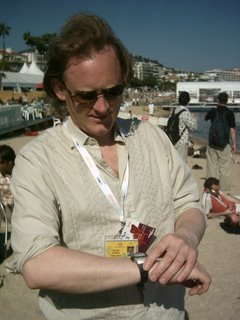
"When's the next meeting?"
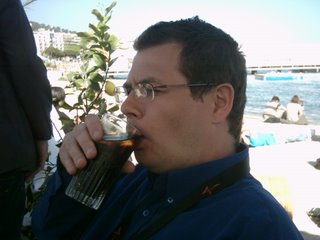
"Tim has an executive Coke."
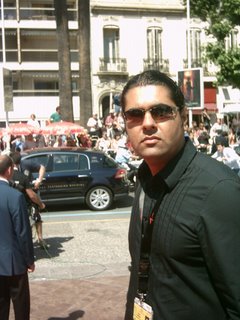
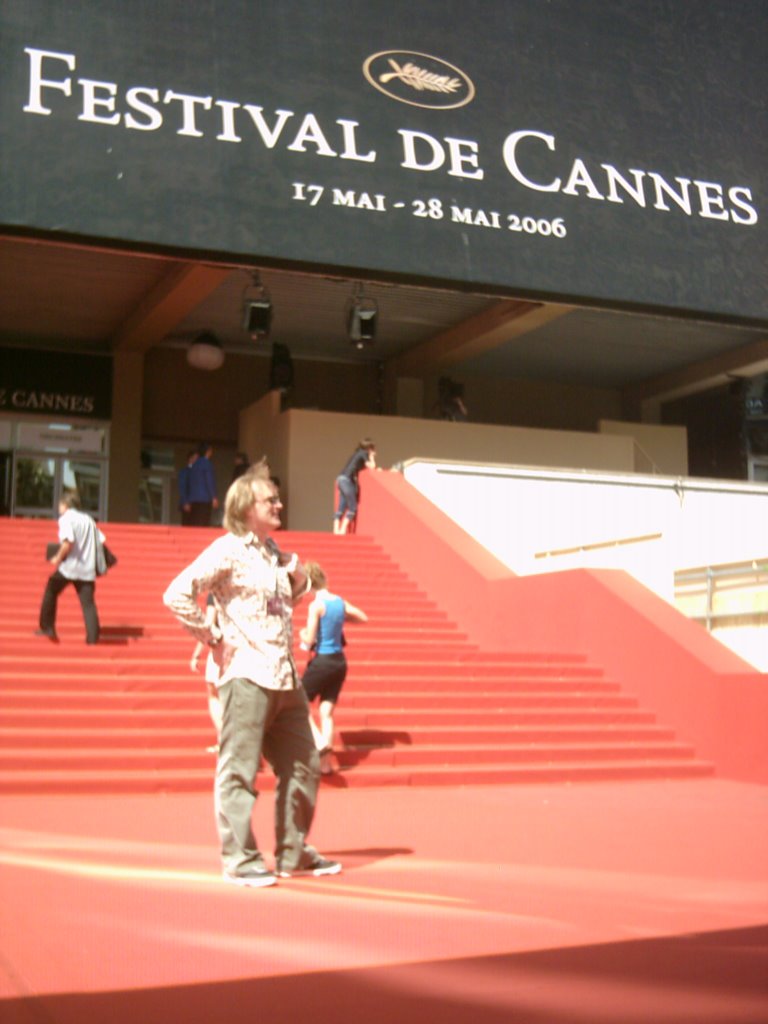
"Suki strikes a Bollywood pose on the red carpet."
"I said I'd be there in a minute, Willem."

Unfortunately, “having passion for film” has become a boring cliché; a phrase anyone with a passing fancy to film to an obsessive dedication with porn can throw around like it’s a badge of validation. We all have a passion for film. It’s a given. It doesn’t need to be said. What matters is how you convey your sense of passion, or bring it to life on-screen, so that it becomes infectious and/or illuminating.
The bad films I saw at the Festival were so obviously borne out of a passion for film but the filmmakers faltered with their communication and expression, and didn’t succeed in transferring their cinematic ardour into satisfying entertainment. A certain amount of kudos and respect needs to be given for having the balls to get up, make something and ‘get it out there’, but in doing so you enter a whole new level of criticism, rejection, adulation and acceptance.
Film and TV has increasingly become the way we explore our humanity and seek to understand ourselves as individuals. This may sound a bit grandiose and excessive seeing as we’re saturated with reality shows and soaps but the media is the main communicative anchor for people to receive, digest and experience their emotions.
Take for example Paul Greengrass’s film United 93. As a filmmaker, he’s excelled himself with his craft and technique. As a cinematic story with dramatic entertainment value (that has to make money), it’s unclear whether it deserves its place in the market. But as a film that brings us a step closer to understanding the complex emotions of September 11, it’s a challenging and curative experience.
Greengrass’s passion and conviction for his subject matter, and his technique, is evident throughout. He’s got a strong and unique voice, a docudrama style that heightens the realism of his stories’ emotions, from Bloody Sunday to Bourne Supremacy to United 93. And that’s what we’re all responsible for as writers and/or filmmakers. We need to find our voice. Our passion. Our defining quality that makes our work noticeable, significant and rewarding.
Being passionate about film just isn’t enough. It’s what you have to say, and how you bring it to the screen. Basic filmmaking techniques will help but ultimately it’s the power and meaning of your story that makes all the difference. This is not meant to sound ostentatious or exclude genre fare in the argument. It just means that if you’re going to do it, then do it well. Otherwise you’ll end up at a market screening in Cannes with people walking out after five minutes, bored and uninspired. Quel domage…
Some photos of the trip...
"When's the next meeting?"

"Tim has an executive Coke."

"Suki strikes a Bollywood pose on the red carpet."
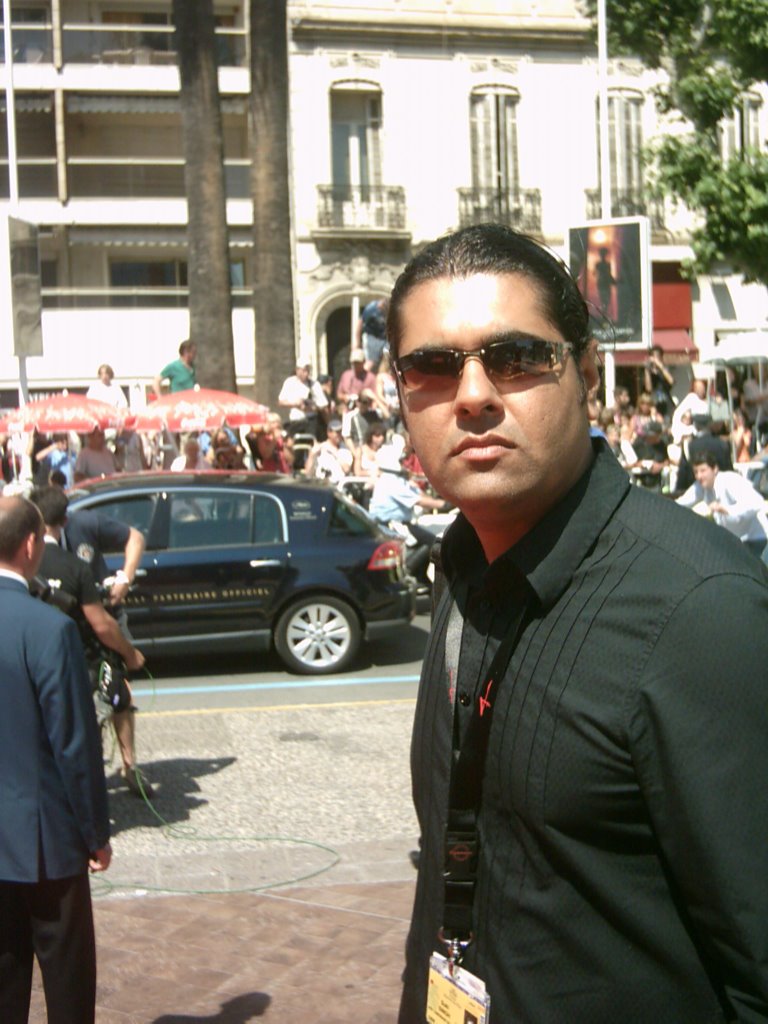
"I said I'd be there in a minute, Willem."
Sabtu, 27 Mei 2006
Cannes'd laughter
Day 5
Last day in Cannes was actually yesterday but didn't get time to post on the blog as me, Tim and Suki lived it large trying to get to as many screenings as possible.
In the morning, I had my first taste of the Palais red carpet, with Tim, as we sauntered up for the morning screening of United 93, Paul Greengrass's film of the doomed flight on Sept 11, and we said a quick hello to Chief Officer Bevan of Working Title along the way.
It was exciting being on the red carpet and Willem Defoe (small! tiny!) was there soaking up the attention. Afterwards, Willem was still strutting his stuff, this time for an Official Selection flick, and myself and Suki went in to check it out. It was called Colossal Youth (I think) but it was a colossal load of rubbish and I fell asleep in a cinema for the very first time in my life.
Yes, it could have been over-tiredness from the hectic week but the film seemed to consist of long dark scenes in a fixed camera position which was enough for me to start snoring. Suki was doing the trademark head-jerk sleep when someone woke us both up as she left the cinema, presumably out of boredom. So we quickly followed her and saw a reasonably passable UK low-budget flick but we came in half-way through so it was difficult to judge. Tim liked it. Although he also liked Material Girls so we're not relying on his expert taste.
Dinner and drinks ensued, and a cheerful recount of the week's events. A terrible sore throat kicked in at around midnight and now I type this from the comfort of my own home feeling like death. The weather's miserable here compared to the south of France and I've got a flu coming on. Great.
I was with an exec from Working Title on the plane, who's just about to assess one of my scripts for consideration, so that was a coincidence. Also an agent from William Morris, who was very nice.
So that's it. Cannes over. Normal service to be resumed next week. Where's my bed?
Last day in Cannes was actually yesterday but didn't get time to post on the blog as me, Tim and Suki lived it large trying to get to as many screenings as possible.
In the morning, I had my first taste of the Palais red carpet, with Tim, as we sauntered up for the morning screening of United 93, Paul Greengrass's film of the doomed flight on Sept 11, and we said a quick hello to Chief Officer Bevan of Working Title along the way.
It was exciting being on the red carpet and Willem Defoe (small! tiny!) was there soaking up the attention. Afterwards, Willem was still strutting his stuff, this time for an Official Selection flick, and myself and Suki went in to check it out. It was called Colossal Youth (I think) but it was a colossal load of rubbish and I fell asleep in a cinema for the very first time in my life.
Yes, it could have been over-tiredness from the hectic week but the film seemed to consist of long dark scenes in a fixed camera position which was enough for me to start snoring. Suki was doing the trademark head-jerk sleep when someone woke us both up as she left the cinema, presumably out of boredom. So we quickly followed her and saw a reasonably passable UK low-budget flick but we came in half-way through so it was difficult to judge. Tim liked it. Although he also liked Material Girls so we're not relying on his expert taste.
Dinner and drinks ensued, and a cheerful recount of the week's events. A terrible sore throat kicked in at around midnight and now I type this from the comfort of my own home feeling like death. The weather's miserable here compared to the south of France and I've got a flu coming on. Great.
I was with an exec from Working Title on the plane, who's just about to assess one of my scripts for consideration, so that was a coincidence. Also an agent from William Morris, who was very nice.
So that's it. Cannes over. Normal service to be resumed next week. Where's my bed?
Kamis, 25 Mei 2006
Films baby
Day 4
Only one meeting today which meant I could actually go and watch some films. In Cannes, it's quite common to walk out of screenings 10/15 minutes if it's not to your liking and unfortunately I've done that with two UK low budget flicks. I won't mention names. But they are awful.
By the way - big shout out to James - the buzz on the Croisette is that Severance kicks ass and everyone's talking about it. Rock.
Anyway, I did see Sherry Baby, the new film with Maggie Gyllenhaal who acts her pants off, sometimes quite literally. Very indie Sundance but very good, especially in comparison with the godawful rubbish we walked out of before hand.
After getting too much sun, I tried to watch Material Girls, the new flick with the American Duff sisters but even though I had read the script a couple of years ago, I couldn't sit through more than 20 minutes of it... Perhaps it's down to Cannes cynicism. Like, what-ever dude.
Typing this in the American Pavilion where it's karaoke night. Some film intern is trying to sing Jack & Diane. Poor bastard. You sing it man. Yeah.
Only one meeting today which meant I could actually go and watch some films. In Cannes, it's quite common to walk out of screenings 10/15 minutes if it's not to your liking and unfortunately I've done that with two UK low budget flicks. I won't mention names. But they are awful.
By the way - big shout out to James - the buzz on the Croisette is that Severance kicks ass and everyone's talking about it. Rock.
Anyway, I did see Sherry Baby, the new film with Maggie Gyllenhaal who acts her pants off, sometimes quite literally. Very indie Sundance but very good, especially in comparison with the godawful rubbish we walked out of before hand.
After getting too much sun, I tried to watch Material Girls, the new flick with the American Duff sisters but even though I had read the script a couple of years ago, I couldn't sit through more than 20 minutes of it... Perhaps it's down to Cannes cynicism. Like, what-ever dude.
Typing this in the American Pavilion where it's karaoke night. Some film intern is trying to sing Jack & Diane. Poor bastard. You sing it man. Yeah.
Rabu, 24 Mei 2006
French Fruitcakes
Day 3 dans le Croissant
Weather much better today, back to what you'd expect for the French Riviera. Sun, sea, sand, and a gentle coastal wind to keep you cool.
The atmosphere's changed too. There are fewer people around and the vibe is less manic. It's relaxed and easy-going, especially as you recognise and acknowledge the strangers who've now grown into familiar faces over the past few days. It feels good, like you've been here for quite a long time.
It's hard work though. Or at least, it feels like hard work even though it's naturally very exciting and fun. Some people are just chilling out and attending the events/seminars - no meeting pressure - and there is a lot to be said for just sitting down and saying Hi to someone next to you. Before you know it, you've got a pocket full of business cards full of writers/producers/directors and shysters.
The UK Pavilion is giving away free fruitcake today which seems quite appropriate as some people go around with a crazed and desperate energy to ingratiate themselves onto anyone who will listen. I just had a very strange meeting with a guy who "likes to be straight" but truthfully, I didn't understand a word he said over the 30 minutes that we were talking. Ah well.
Tres bon. Allez.
Weather much better today, back to what you'd expect for the French Riviera. Sun, sea, sand, and a gentle coastal wind to keep you cool.
The atmosphere's changed too. There are fewer people around and the vibe is less manic. It's relaxed and easy-going, especially as you recognise and acknowledge the strangers who've now grown into familiar faces over the past few days. It feels good, like you've been here for quite a long time.
It's hard work though. Or at least, it feels like hard work even though it's naturally very exciting and fun. Some people are just chilling out and attending the events/seminars - no meeting pressure - and there is a lot to be said for just sitting down and saying Hi to someone next to you. Before you know it, you've got a pocket full of business cards full of writers/producers/directors and shysters.
The UK Pavilion is giving away free fruitcake today which seems quite appropriate as some people go around with a crazed and desperate energy to ingratiate themselves onto anyone who will listen. I just had a very strange meeting with a guy who "likes to be straight" but truthfully, I didn't understand a word he said over the 30 minutes that we were talking. Ah well.
Tres bon. Allez.
Selasa, 23 Mei 2006
How does it End?
Day 2 in Cannes
Most common question asked in pitches so far. Not 'what it's about' but 'how does it end'? Interesting and challenging question as you want to impress the hell out of them with your story's resonant resolution.
All is going well along the Croissette. It's much cooler and windier today, a suggestion of rain, and the general mood seems to be quieter and more laid back than yesterday. People winding down, apparently, and going home. I'm here 'till Saturday but have meetings lined up until Friday.
Most of the meetings were set up prior to arrival by using the Cannes Market database and going through it to target potential producers/investors/fairy godmothers for my projects. I sent about 200 emails to which I got about a 10% response and it's broken down roughly into four meetings per day, all of which subject to change or removal.
The best approach for the meetings has been to talk to the people rather than actively pitch them with an over-zealous energy. Tell them about yourself and what you're up to. It's more about making contacts and setting up possible relationships than actually closing a development deal. It's not a writers' festival but it's great to be here to meet new and influential people. If they are interested in your scripts, then you can tell them what they're about but in a more relaxed, conversational style, and seems to work a lot better than spellbinding them with pitch trick no.53.
Quite tired now. Energy dip. Going to have a coffee. Still a long day ahead.
Most common question asked in pitches so far. Not 'what it's about' but 'how does it end'? Interesting and challenging question as you want to impress the hell out of them with your story's resonant resolution.
All is going well along the Croissette. It's much cooler and windier today, a suggestion of rain, and the general mood seems to be quieter and more laid back than yesterday. People winding down, apparently, and going home. I'm here 'till Saturday but have meetings lined up until Friday.
Most of the meetings were set up prior to arrival by using the Cannes Market database and going through it to target potential producers/investors/fairy godmothers for my projects. I sent about 200 emails to which I got about a 10% response and it's broken down roughly into four meetings per day, all of which subject to change or removal.
The best approach for the meetings has been to talk to the people rather than actively pitch them with an over-zealous energy. Tell them about yourself and what you're up to. It's more about making contacts and setting up possible relationships than actually closing a development deal. It's not a writers' festival but it's great to be here to meet new and influential people. If they are interested in your scripts, then you can tell them what they're about but in a more relaxed, conversational style, and seems to work a lot better than spellbinding them with pitch trick no.53.
Quite tired now. Energy dip. Going to have a coffee. Still a long day ahead.
Senin, 22 Mei 2006
Cannes you dig it?
Day one on the French Riviera.
Hah!
Suckers.
Seriously. Arrived late last night after a nightmare journey. Absolutely torrential rain and wind on my walk to train station to take me to Gatwick (cursing my decision not to drive) so I travel to airport soaked to the skin and hugely uncomfortable. Then the flight's delayed so my 10pm meeting with a director in the Petit Majestic is immediately stricken off the schedule.
Touch down in Nice and wait for-ever for my bag but then a bit of luck. Two good looking actresses target me (naturally) to share a cab with them to Cannes. So I graciously agree to help out. I'm in my hotel at midnight using my frugal French to try to book in. Il faut payez maintenant? "Do I have to pay now?" You bet your ass.
It's hot and I'm stressed (nervous) so I don't get much sleep. I hook up with Bournemouth legends Tim Clague and Suki Singh who hold my hand down to the Palais in order for me to get my accreditation and go on my merry way. I've got meetings scheduled throughout the day but the first exec calls to cancel. Still, it gives me time to get the know of the land and chill out.
I find my feet and ease into the rapport of the meetings. It's great. It's still hot. But who am I to complain. I'm typing this in the American Pavilion and the first exec calls to rearrange our meeting for right now, which is fine by me. So I'm off for my last meeting of the day before I retire for Cobra Beer hour at the UK Pavilion. God bless Indian beer.
Hah!
Suckers.
Seriously. Arrived late last night after a nightmare journey. Absolutely torrential rain and wind on my walk to train station to take me to Gatwick (cursing my decision not to drive) so I travel to airport soaked to the skin and hugely uncomfortable. Then the flight's delayed so my 10pm meeting with a director in the Petit Majestic is immediately stricken off the schedule.
Touch down in Nice and wait for-ever for my bag but then a bit of luck. Two good looking actresses target me (naturally) to share a cab with them to Cannes. So I graciously agree to help out. I'm in my hotel at midnight using my frugal French to try to book in. Il faut payez maintenant? "Do I have to pay now?" You bet your ass.
It's hot and I'm stressed (nervous) so I don't get much sleep. I hook up with Bournemouth legends Tim Clague and Suki Singh who hold my hand down to the Palais in order for me to get my accreditation and go on my merry way. I've got meetings scheduled throughout the day but the first exec calls to cancel. Still, it gives me time to get the know of the land and chill out.
I find my feet and ease into the rapport of the meetings. It's great. It's still hot. But who am I to complain. I'm typing this in the American Pavilion and the first exec calls to rearrange our meeting for right now, which is fine by me. So I'm off for my last meeting of the day before I retire for Cobra Beer hour at the UK Pavilion. God bless Indian beer.
Jumat, 19 Mei 2006
Weekend Noticeboard
I’m going to Cannes on Sunday so what I’ll try to do is blog about my Riviera adventure while I’m there. Somewhat pleasingly, my 200th post will hopefully come from somewhere along the Croissette.
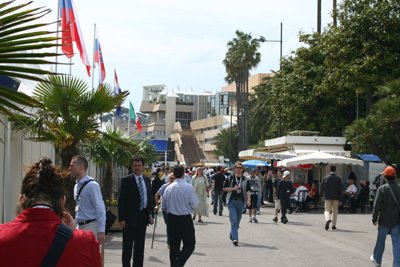
 I’m told there are free internet connections available but there may also be queues so I don’t how lucky or likely I’ll be to go on-line. I’m sure I’ll get at least one post relayed and if that should be the case, then I’ll have a round-up of events when I get back.
It’s my first time at Cannes so I’m equally nervous and excited. I’ve managed to line up a few meetings, which should be interesting, and my producer for Origin has also got plans to target a few key movers and shakers for their development and co-production dosh. I’m not going with any great expectations though as it’s not really a festival for writers. I just want to see what it’s all about, have a few meetings, make some useful contacts and enjoy myself.
So, have a great weekend everyone. See you next week!
---
BBC’s Comedy Soup
The BBC has launched a new website offering a platform for new comedy clips. Comedy Soup enables any would-be writer or performer to create short films and post them on the internet, in a similar way to community sites such as Myspace and YouTube.
To coincide with the launch, BBC Three has announced a talent- hunt to find the best contributions. The creators of the funniest material, as judged by a panel of industry experts, will take part in a series of masterclasses with established comedy writers, performers and producers in Manchester, to help hone their skills.
Video clips – including stand-up and sketches - or animation clips must be submitted by July 14 to qualify for the Funny Hunt competition. The BBC has also released photographs, sound and video clips from its archives on to the Comedy Soup, which it will allow people to use to create content for the site.
---
Intern required at Capitol Films
Capitol Films Production and Capitol Films are running an on-going development internship scheme based in London. The internship will offer successful applicants insight, experience and contacts in feature film development, production, sales and distribution. The intern will receive on-the-job training as they assist CFP's Head of Production and Capitol Films' Head of Development and Acquisitions in their day-to-day business over the course of thirteen weeks. Successful candidates will be contracted to work a 40 hour week, at minimum wage salary. Submissions close on 26 May 2006 for the next placement which will commence on 2 July 2006. For an application form please e-mail intern-development@capitolfilms.com.
---
Writer Vacancy
We currently have a vacancy for a writer at our company based in the North East of England. The position is permanent with a salary ranging from 15 - 18k p/a depending upon experience. Details of the company can be found on our website. Please email CVs to: enquiries@twentyfirstcenturymedia.com
---
CALLING ALL WRITERS
A new Sheffield production company is looking to part finance a 16mm 10 Minute film and is searching for submissions from writers.
This could be a fantastic opportunity to develop as an independent with a production company. We are open to any genre and theme providing it is no longer or shorter than 10 minutes. We are hoping to have a period of script development so writers must be prepared to work both with a director and a producer as some changes may be required.
Please submit two copies of the script with contact details clearly shown. The script should be in industry format.
Post to: NEGGLE FILMS, ROOM 14, SHEFFIELD INDEPENDENT FILM, 5 BROWN STREET, SHEFFIELD, S1 2BS
---
Arista Story Development Workshop
Arista is pleased to let you know that it is now accepting applications for the next residential Story Development Workshop which is set to take place in Platres, Cyprus from 1st - 8th of July. The cut-off deadline will be Monday, 5th of June (only a few weeks away), but keep in mind that as we consider all applications when they arrive, we'd like to encourage you to submit sooner than later. You can apply, and read all about our recognised MEDIA supported course on our website. Additionally, get in touch with us directly to discuss.
If you are planning to apply from the UK, and would like to explore the possibility of financial support, have a look at our free UK Training Bursary Guide, also available from our website.
Please note that applications for the June Story Development Workshop in Sirolo, Italy are now closed. We look forward to your application! Tel: +44 (0) 20 7323 1775 | Fax: +44 (0) 20 7323 1772 Email: michael@aristotle.co.uk
---
Script Factory’s SCENE Insiders
The Script Factory are gearing up for its third year of SCENE insiders - an unmissable script development training programme offering a line-up of workshops, screenings, masterclasses and a fantastic opportunity to network with some of Europe’s most talented new filmmakers.
SCENE insiders takes 3 groups of European participants to international film festivals at Edinburgh, Warsaw 2006 or Gothenburg 2007. FIRST APPLICATION DEADLINE - FRIDAY 23 JUNE 2006.
Dates:
Edinburgh:18 – 20 August 2006
Warsaw: 6 – 8 October 2006
Gothenburg: 29 – 31 January 2007
For more information visit Script Factory’s website or email ana@scriptfactroy.co.uk
---
So You Want to Write TV Drama?
The highly aclaimed "So You Want To Write TV Drama?" class heads North in June and July.
There are hundreds of "How to write" courses. This isn't one of them. Led by award winning writer and director Adrian Mead the course teaches what a writer would normally learn after working 2-3 years in TV, such as -
: Working with Script Editors and producers
: How to get an Agent.
: How to get that first break and sell your work.
: Handling rewrites.
This unique one day class is suitable for both enthusiastic beginners and experienced writers. A FREE 15 PAGE BOOKLET of tips is now available from info@meadkerr.com.
CLASS DATES:
Saturday 3rd June @ St Magnus Centre, Orkney
Saturday 1st July @ Kenneth St Hall. Kenneth St, Inverness
COURSE FEE: £40 incl VAT and refreshments. Payable in advance. e-mail info@meadkerr.com or call on 0131 554 4539. Mead Kerr website
***
 I’m told there are free internet connections available but there may also be queues so I don’t how lucky or likely I’ll be to go on-line. I’m sure I’ll get at least one post relayed and if that should be the case, then I’ll have a round-up of events when I get back.
 It’s my first time at Cannes so I’m equally nervous and excited. I’ve managed to line up a few meetings, which should be interesting, and my producer for Origin has also got plans to target a few key movers and shakers for their development and co-production dosh. I’m not going with any great expectations though as it’s not really a festival for writers. I just want to see what it’s all about, have a few meetings, make some useful contacts and enjoy myself.
So, have a great weekend everyone. See you next week!
---
BBC’s Comedy Soup
The BBC has launched a new website offering a platform for new comedy clips. Comedy Soup enables any would-be writer or performer to create short films and post them on the internet, in a similar way to community sites such as Myspace and YouTube.
To coincide with the launch, BBC Three has announced a talent- hunt to find the best contributions. The creators of the funniest material, as judged by a panel of industry experts, will take part in a series of masterclasses with established comedy writers, performers and producers in Manchester, to help hone their skills.
Video clips – including stand-up and sketches - or animation clips must be submitted by July 14 to qualify for the Funny Hunt competition. The BBC has also released photographs, sound and video clips from its archives on to the Comedy Soup, which it will allow people to use to create content for the site.
---
Intern required at Capitol Films
Capitol Films Production and Capitol Films are running an on-going development internship scheme based in London. The internship will offer successful applicants insight, experience and contacts in feature film development, production, sales and distribution. The intern will receive on-the-job training as they assist CFP's Head of Production and Capitol Films' Head of Development and Acquisitions in their day-to-day business over the course of thirteen weeks. Successful candidates will be contracted to work a 40 hour week, at minimum wage salary. Submissions close on 26 May 2006 for the next placement which will commence on 2 July 2006. For an application form please e-mail intern-development@capitolfilms.com.
---
Writer Vacancy
We currently have a vacancy for a writer at our company based in the North East of England. The position is permanent with a salary ranging from 15 - 18k p/a depending upon experience. Details of the company can be found on our website. Please email CVs to: enquiries@twentyfirstcenturymedia.com
---
CALLING ALL WRITERS
A new Sheffield production company is looking to part finance a 16mm 10 Minute film and is searching for submissions from writers.
This could be a fantastic opportunity to develop as an independent with a production company. We are open to any genre and theme providing it is no longer or shorter than 10 minutes. We are hoping to have a period of script development so writers must be prepared to work both with a director and a producer as some changes may be required.
Please submit two copies of the script with contact details clearly shown. The script should be in industry format.
Post to: NEGGLE FILMS, ROOM 14, SHEFFIELD INDEPENDENT FILM, 5 BROWN STREET, SHEFFIELD, S1 2BS
---
Arista Story Development Workshop
Arista is pleased to let you know that it is now accepting applications for the next residential Story Development Workshop which is set to take place in Platres, Cyprus from 1st - 8th of July. The cut-off deadline will be Monday, 5th of June (only a few weeks away), but keep in mind that as we consider all applications when they arrive, we'd like to encourage you to submit sooner than later. You can apply, and read all about our recognised MEDIA supported course on our website. Additionally, get in touch with us directly to discuss.
If you are planning to apply from the UK, and would like to explore the possibility of financial support, have a look at our free UK Training Bursary Guide, also available from our website.
Please note that applications for the June Story Development Workshop in Sirolo, Italy are now closed. We look forward to your application! Tel: +44 (0) 20 7323 1775 | Fax: +44 (0) 20 7323 1772 Email: michael@aristotle.co.uk
---
Script Factory’s SCENE Insiders
The Script Factory are gearing up for its third year of SCENE insiders - an unmissable script development training programme offering a line-up of workshops, screenings, masterclasses and a fantastic opportunity to network with some of Europe’s most talented new filmmakers.
SCENE insiders takes 3 groups of European participants to international film festivals at Edinburgh, Warsaw 2006 or Gothenburg 2007. FIRST APPLICATION DEADLINE - FRIDAY 23 JUNE 2006.
Dates:
Edinburgh:18 – 20 August 2006
Warsaw: 6 – 8 October 2006
Gothenburg: 29 – 31 January 2007
For more information visit Script Factory’s website or email ana@scriptfactroy.co.uk
---
So You Want to Write TV Drama?
The highly aclaimed "So You Want To Write TV Drama?" class heads North in June and July.
There are hundreds of "How to write" courses. This isn't one of them. Led by award winning writer and director Adrian Mead the course teaches what a writer would normally learn after working 2-3 years in TV, such as -
: Working with Script Editors and producers
: How to get an Agent.
: How to get that first break and sell your work.
: Handling rewrites.
This unique one day class is suitable for both enthusiastic beginners and experienced writers. A FREE 15 PAGE BOOKLET of tips is now available from info@meadkerr.com.
CLASS DATES:
Saturday 3rd June @ St Magnus Centre, Orkney
Saturday 1st July @ Kenneth St Hall. Kenneth St, Inverness
COURSE FEE: £40 incl VAT and refreshments. Payable in advance. e-mail info@meadkerr.com or call on 0131 554 4539. Mead Kerr website
***
Rabu, 17 Mei 2006
Endings
What’s that over there? There, just coming into view. It’s as clear as day. You can see it from a mile off. It’s… it’s… the predictable ending to a film.
If openings are easy and the second act is hard, then endings are a total bitch. And what’s worse is that in this day and age, audiences have become so sophisticated (armchair storytellers if you will) that they can anticipate dialogue and key events a good half hour or more than the scenes are supposed to appear on screen.
They’ll run through all the possible endings in their head and quickly analyse all of the different story routes through the logic of what’s been presented to them so far. A lot of spec screenplays make their endings, or key twists, very predictable. As soon as the story establishes one certain story expectation, the audience is already filling the blanks and wants to see their anticipation challenged at the very least.
Even if the script is as predictable as a rom com (where the guy & girl will get together) or a cop thriller (where the good guy will catch the baddie), the way it achieves these resolutions is the key to audience satisfaction. There are certain endings or story developments that are unavoidable but that doesn’t mean that they should be predictable.
Let’s make a brief mention of Seven. Morgan Freeman and Brad Pitt out to catch bad guy Kevin Spacey. They’re going to get him, right? They’re going to save the day. Well, yes, and no. Spacey gives himself up. Who saw that coming? And then he delivers Pitt’s wife head in a box to complete his murder masterpiece. What an ending. What a finale. Miserable as hell but riveting and unpredictable.
Rom coms have a hard time coming up with the goods because it’s easy to deliver a by-the-numbers script rather than genuinely challenge the characters and story to avoid a predictable outcome. Yes, we want to see the romantic couple get together but it doesn’t have to be too conventional or unsurprising. Shake it up a bit. Even the most predictable of outcomes can be acceptable and entertaining if the characters EARN the resolution rather than have it handed to them on a contrived plate.
It’s all about twists and turns. Leading the story one way before twisting it another. Keeping the audience on their toes so that even if they see something coming, they’ll accept it once it arrives because the characters and scenes will have worked hard to get it there. ‘Twists and turns’ doesn’t mean breathtaking dramatic developments, it just means keeping the plot alive to the characters so that they face, and create, increasing conflict in their individual desires and goals.
And then, when the ending comes, everyone goes home happy.
If openings are easy and the second act is hard, then endings are a total bitch. And what’s worse is that in this day and age, audiences have become so sophisticated (armchair storytellers if you will) that they can anticipate dialogue and key events a good half hour or more than the scenes are supposed to appear on screen.
They’ll run through all the possible endings in their head and quickly analyse all of the different story routes through the logic of what’s been presented to them so far. A lot of spec screenplays make their endings, or key twists, very predictable. As soon as the story establishes one certain story expectation, the audience is already filling the blanks and wants to see their anticipation challenged at the very least.
Even if the script is as predictable as a rom com (where the guy & girl will get together) or a cop thriller (where the good guy will catch the baddie), the way it achieves these resolutions is the key to audience satisfaction. There are certain endings or story developments that are unavoidable but that doesn’t mean that they should be predictable.
Let’s make a brief mention of Seven. Morgan Freeman and Brad Pitt out to catch bad guy Kevin Spacey. They’re going to get him, right? They’re going to save the day. Well, yes, and no. Spacey gives himself up. Who saw that coming? And then he delivers Pitt’s wife head in a box to complete his murder masterpiece. What an ending. What a finale. Miserable as hell but riveting and unpredictable.
Rom coms have a hard time coming up with the goods because it’s easy to deliver a by-the-numbers script rather than genuinely challenge the characters and story to avoid a predictable outcome. Yes, we want to see the romantic couple get together but it doesn’t have to be too conventional or unsurprising. Shake it up a bit. Even the most predictable of outcomes can be acceptable and entertaining if the characters EARN the resolution rather than have it handed to them on a contrived plate.
It’s all about twists and turns. Leading the story one way before twisting it another. Keeping the audience on their toes so that even if they see something coming, they’ll accept it once it arrives because the characters and scenes will have worked hard to get it there. ‘Twists and turns’ doesn’t mean breathtaking dramatic developments, it just means keeping the plot alive to the characters so that they face, and create, increasing conflict in their individual desires and goals.
And then, when the ending comes, everyone goes home happy.
Selasa, 16 Mei 2006
Speed Reading
It may sound obvious to say it but one of the most important qualities in a script reader is that they have a genuine interest in reading scripts. A lot of people ask me how to become a script reader, and how many scripts a week they should read “before they move on” and I don’t know quite how to answer them.
In truth, you never “move on” from being a reader. You just stop reading and do something else. The fact that the ‘something else’ may be a more appealing job position, and the script reading helped you get there, is beside the point. Script reading is a tough job and should not be viewed as a handy stepping stone ahead of the runner/receptionist. Too many people view it as such and don’t last a week because they struggle to read and do coverage on a measly four scripts.
You’ve got to want to read scripts. You should be interested in the craft of screenwriting, and be reasonably knowledgeable about the industry, so that it informs your growing experience and opinion on what makes a good script tick. The good readers settle into this routine with casual aplomb. They won’t blanch or shudder at the sight of a ten script pile that has to be covered by the end of the week. They’ll get the work done and while it may not be enjoyable in the sense of reading entertainment, it will cement their reputation as reliable and efficient readers.
And as the efficiency grows, so does the speed of reading. This may be a bad thing as no doubt writers, producers and directors will bemoan the fact the reader is not carefully assessing their story. I can understand this complaint but as a reader, I would say that the speed of reading comes about from a familiarity with how stories are presented and subsequently unravel. A lot of scripts follow the same mediocre path. When a good or great script comes along, a script reader is riveted to the story and only too keen to give it a glowing report. And the speed in which the script is covered does not blemish the recommendation.
Speed reading becomes part of the process for the reader, the nuts and bolts of getting their work done. A script’s page count can be guessed just by the feel and weight of the sprightly tome. If it’s under 100 pages, it can be read in an hour. Anything over that, usually an hour and a half. If a script takes two hours or more to read, something is seriously wrong.
Similarly, a reader can assess how much time it will take him to read and cover a book. A standard print book of about 200 pages will take (me) about four hours to read. 50 pages per hour, taking notes as I go. One week, I covered 10 scripts and four books. That’s the most I’ve ever done. Reading like a lunatic to try to make ends meet near the beginning of my scriptwriting/script reading career. But by doing so, I got the process down to a fine routine. In general, an hour to read a script, half an hour to write the coverage (I touch-type fast).
This means I could read a book in the morning, then take a break for lunch and read two scripts in the afternoon and have their coverage finished by tea time. Not bad for a day’s work. Sure, it’s demanding and gruelling but that’s the nature of script reading. Good readers will find themselves sucked into the vortex of mass coverage and continuous work before, slowly, they either lose the will to live or move on with their writing career. And that’s when you stop. You don’t move on. You just do something else.
In truth, you never “move on” from being a reader. You just stop reading and do something else. The fact that the ‘something else’ may be a more appealing job position, and the script reading helped you get there, is beside the point. Script reading is a tough job and should not be viewed as a handy stepping stone ahead of the runner/receptionist. Too many people view it as such and don’t last a week because they struggle to read and do coverage on a measly four scripts.
You’ve got to want to read scripts. You should be interested in the craft of screenwriting, and be reasonably knowledgeable about the industry, so that it informs your growing experience and opinion on what makes a good script tick. The good readers settle into this routine with casual aplomb. They won’t blanch or shudder at the sight of a ten script pile that has to be covered by the end of the week. They’ll get the work done and while it may not be enjoyable in the sense of reading entertainment, it will cement their reputation as reliable and efficient readers.
And as the efficiency grows, so does the speed of reading. This may be a bad thing as no doubt writers, producers and directors will bemoan the fact the reader is not carefully assessing their story. I can understand this complaint but as a reader, I would say that the speed of reading comes about from a familiarity with how stories are presented and subsequently unravel. A lot of scripts follow the same mediocre path. When a good or great script comes along, a script reader is riveted to the story and only too keen to give it a glowing report. And the speed in which the script is covered does not blemish the recommendation.
Speed reading becomes part of the process for the reader, the nuts and bolts of getting their work done. A script’s page count can be guessed just by the feel and weight of the sprightly tome. If it’s under 100 pages, it can be read in an hour. Anything over that, usually an hour and a half. If a script takes two hours or more to read, something is seriously wrong.
Similarly, a reader can assess how much time it will take him to read and cover a book. A standard print book of about 200 pages will take (me) about four hours to read. 50 pages per hour, taking notes as I go. One week, I covered 10 scripts and four books. That’s the most I’ve ever done. Reading like a lunatic to try to make ends meet near the beginning of my scriptwriting/script reading career. But by doing so, I got the process down to a fine routine. In general, an hour to read a script, half an hour to write the coverage (I touch-type fast).
This means I could read a book in the morning, then take a break for lunch and read two scripts in the afternoon and have their coverage finished by tea time. Not bad for a day’s work. Sure, it’s demanding and gruelling but that’s the nature of script reading. Good readers will find themselves sucked into the vortex of mass coverage and continuous work before, slowly, they either lose the will to live or move on with their writing career. And that’s when you stop. You don’t move on. You just do something else.
Senin, 15 Mei 2006
Script Vs Film: 16 Blocks
Most screenwriters dream of generating a manic bidding war between the big Hollywood studios over their latest spec. Most screenwriters know that all they have to do is come up with that ‘great movie idea’ where the story will instantly unfold in the producer’s mind as soon as he hears the title. Ker-ching. Make that sale baby. And most screenwriters will spend nearly all of their time chewing and fretting over their keyboards in an attempt to attain this nigh-on impossible dream.
But here’s the key: simplicity. You’ll find that a lot of the greatest movie ideas, and screenplays, have an enviable ease to their concept’s core. This specifically refers to ‘genre’ movies. Tentpole pictures (a big summer blockbuster), crime thrillers, romantic comedies, horrors etc. A check through some of the more successful genre flicks will reveal instant appeal with only a casual once-over of the films’ loglines.
They may not be big or clever but they usually suggest that they’ll provide enough popcorn entertainment to make a studio want to get involved. The PROTAGONIST/HERO is easily identifiable, his GOAL basic and clear, and his CONFLICT just as comprehensible. Let’s take a look at 16 Blocks, written by Richard Wenk, directed by Richard Donner and starring Bruce Willis and Mos Def.
Usually you’d expect a certain amount of scorn from both critics and aspiring screenwriters over this type of movie but let’s face it, if you could write a script that would not only sell to the studios but also attract the interest of legendary director Donner and the star power of Willis and Def, then you’d probably bite off your right arm and feed it to yourself in order to make it happen.
Here’s my logline: “A has-been cop has to take a witness sixteen blocks to the courthouse but their trip becomes a minefield of shoot-outs and obstacles as the witness holds the key to police corruption.”
And my brief: “A neat premise is given some effective action and structure but the characterisation and plot slips into easy pockets of cliché and the good guy cop versus the bad guy cops was hard to swallow, despite the ‘twist’ at the end.”
My comments follow. BEWARE: I reveal the film’s big twist and discuss other spoilers. If you’re going to see 16 Blocks, finish reading this post after you’ve been.
“This has a simple and effective premise. A has-been cop has to take a witness sixteen blocks to the courthouse but because the witness is testifying against other policemen, the sixteen block trip becomes fraught with danger. It’s not a high concept movie in the sense that an audience will go to see the film based on the premise alone but it does qualify as a high concept flick because the protagonist’s goal and obstacle is clear and succinct.
The protagonist has a simple task but he’s faced with constant obstacle and opposition. It’s a basic lesson in screenwriting and this script presents itself as a polished genre piece with a solid concept and reliable structure. The premise actually dictates what structure the plot will follow but the writer does well to keep matters reasonably unpredictable and interesting.
But there’s a problem. A few problems. The characterisation and plot detail fall into familiarity and cliché, and do not treat the audience with enough respect. Bruce Willis’s role is the has-been, drunk cop who wants to redeem himself by doing the right thing with Eddie Bunker, the young witness. This is trite and cliché, and didn’t do the early stages of the plot any favours.
It gets worse when Bruce’s cop colleagues turn out to be a nasty bunch of criminals themselves, the very cops that Bruce’s witness is going to testify against. Bruce’s antagonist, Nugent, gamely tries to give justifiable reasons why Eddie should be shot but Bruce decides “no godammit” and gets knee deep in his task to get Eddie to the courthouse on time.
The shoot outs and chases provide good value, up to a point. We’ve pretty much seen this kind of thing in TV cops shows and a hundred other cop films but it all ambles along to a rolling pace and slotted structure, so you can’t go too wrong with what’s going on.
One of the film’s highlights, or maybe that should read ‘more interesting segments’, is when Jack (Bruce) and Eddie take a bus hostage. This raised the bar somewhat and gave the plot more bite because previously it had been working on Jack and Eddie on foot and sigh, getting to know each other. But Jack and Eddie’s characterisation is not very convincing. Jack’s a walking cliché while Eddie’s character is too unbelievable and unrealistic, especially with the case in hand.
For most of the film, the reader is thinking that there’s no way that Nugent, a clever homicide cop, will let Jack and Eddie out of his sight and the writer just, just, gets away with keeping Nugent one step behind. But it all comes to a head in a silly and unsatisfactory manner. After all of Nugent’s nous, Jack easily captures him inside a church (where an affable priest is pleased to see Jack come to church again) and then Jack reveals the ‘twist’ of the film.
The ‘twist’ is that Jack used to be one of Nugent’s corrupt cops so Jack’s determined effort to get Eddie to the courthouse goes a bit beyond Jack just trying to do the right thing. He wants to redeem himself fully from his experiences with Nugent. This is fair enough, it does give some added juice to the plot and characterisation, but it’s just too darn noble.
While Jack’s decision to go against his peers might work on celluloid, in reality it would take a lot more soul searching and justifiable action to come to such a devastating decision. In this flick, it’s Jack’s experience with the amiable Eddie that makes Jack realise he’s got a little bit more petrol left in his tank but the issue of corrupt cops and the necessary corruption they have to take is glossed over in favour of a basic right and wrong that doesn’t fully serve the film.”
But here’s the key: simplicity. You’ll find that a lot of the greatest movie ideas, and screenplays, have an enviable ease to their concept’s core. This specifically refers to ‘genre’ movies. Tentpole pictures (a big summer blockbuster), crime thrillers, romantic comedies, horrors etc. A check through some of the more successful genre flicks will reveal instant appeal with only a casual once-over of the films’ loglines.
They may not be big or clever but they usually suggest that they’ll provide enough popcorn entertainment to make a studio want to get involved. The PROTAGONIST/HERO is easily identifiable, his GOAL basic and clear, and his CONFLICT just as comprehensible. Let’s take a look at 16 Blocks, written by Richard Wenk, directed by Richard Donner and starring Bruce Willis and Mos Def.
Usually you’d expect a certain amount of scorn from both critics and aspiring screenwriters over this type of movie but let’s face it, if you could write a script that would not only sell to the studios but also attract the interest of legendary director Donner and the star power of Willis and Def, then you’d probably bite off your right arm and feed it to yourself in order to make it happen.
Here’s my logline: “A has-been cop has to take a witness sixteen blocks to the courthouse but their trip becomes a minefield of shoot-outs and obstacles as the witness holds the key to police corruption.”
And my brief: “A neat premise is given some effective action and structure but the characterisation and plot slips into easy pockets of cliché and the good guy cop versus the bad guy cops was hard to swallow, despite the ‘twist’ at the end.”
My comments follow. BEWARE: I reveal the film’s big twist and discuss other spoilers. If you’re going to see 16 Blocks, finish reading this post after you’ve been.
“This has a simple and effective premise. A has-been cop has to take a witness sixteen blocks to the courthouse but because the witness is testifying against other policemen, the sixteen block trip becomes fraught with danger. It’s not a high concept movie in the sense that an audience will go to see the film based on the premise alone but it does qualify as a high concept flick because the protagonist’s goal and obstacle is clear and succinct.
The protagonist has a simple task but he’s faced with constant obstacle and opposition. It’s a basic lesson in screenwriting and this script presents itself as a polished genre piece with a solid concept and reliable structure. The premise actually dictates what structure the plot will follow but the writer does well to keep matters reasonably unpredictable and interesting.
But there’s a problem. A few problems. The characterisation and plot detail fall into familiarity and cliché, and do not treat the audience with enough respect. Bruce Willis’s role is the has-been, drunk cop who wants to redeem himself by doing the right thing with Eddie Bunker, the young witness. This is trite and cliché, and didn’t do the early stages of the plot any favours.
It gets worse when Bruce’s cop colleagues turn out to be a nasty bunch of criminals themselves, the very cops that Bruce’s witness is going to testify against. Bruce’s antagonist, Nugent, gamely tries to give justifiable reasons why Eddie should be shot but Bruce decides “no godammit” and gets knee deep in his task to get Eddie to the courthouse on time.
The shoot outs and chases provide good value, up to a point. We’ve pretty much seen this kind of thing in TV cops shows and a hundred other cop films but it all ambles along to a rolling pace and slotted structure, so you can’t go too wrong with what’s going on.
One of the film’s highlights, or maybe that should read ‘more interesting segments’, is when Jack (Bruce) and Eddie take a bus hostage. This raised the bar somewhat and gave the plot more bite because previously it had been working on Jack and Eddie on foot and sigh, getting to know each other. But Jack and Eddie’s characterisation is not very convincing. Jack’s a walking cliché while Eddie’s character is too unbelievable and unrealistic, especially with the case in hand.
For most of the film, the reader is thinking that there’s no way that Nugent, a clever homicide cop, will let Jack and Eddie out of his sight and the writer just, just, gets away with keeping Nugent one step behind. But it all comes to a head in a silly and unsatisfactory manner. After all of Nugent’s nous, Jack easily captures him inside a church (where an affable priest is pleased to see Jack come to church again) and then Jack reveals the ‘twist’ of the film.
The ‘twist’ is that Jack used to be one of Nugent’s corrupt cops so Jack’s determined effort to get Eddie to the courthouse goes a bit beyond Jack just trying to do the right thing. He wants to redeem himself fully from his experiences with Nugent. This is fair enough, it does give some added juice to the plot and characterisation, but it’s just too darn noble.
While Jack’s decision to go against his peers might work on celluloid, in reality it would take a lot more soul searching and justifiable action to come to such a devastating decision. In this flick, it’s Jack’s experience with the amiable Eddie that makes Jack realise he’s got a little bit more petrol left in his tank but the issue of corrupt cops and the necessary corruption they have to take is glossed over in favour of a basic right and wrong that doesn’t fully serve the film.”
Jumat, 12 Mei 2006
Weekend Noticeboard
Not much information to share with you this weekend. Seems to have gone a bit quiet in the build up to Cannes and with the weather getting nicer.
There’s the update on the Screenwriters’ Festival regarding accommodation, how to get there and the New Writers’ Day (which takes place the day before the festival officially starts).
Mark Huckerby (who will be on a panel discussion at the festival) gave me this link which is an interesting article about how the film industry is looking to writers outside of the field of screenwriting to write future hits at the cinema because the “common screenwriting talent” (inverted commas my own) don’t seem to be quite up to scratch. I’m particularly annoyed in the article’s apparent assumption that TV writers aren’t screenwriters, or not as skilful as the writers who fill the wide and wonderful canvas of film.
Occasionally, the TV and film industry likes to lay the blame and point the finger at writers for the lack of quality projects available but sometimes when they get a brilliant script across their laps, they don’t know what to do with it, or seem incapable of raising the required budget to fund the project! (ahem, Aliens FC) And then the script goes to waste. I believe passionately that there are a lot of talented screenwriters out there (I’m including TV writers and myself, modesty aside).
While there is unarguably a lot of dross and poorly written scripts in circulation (one reader recently said to me: "there's only so long you can read scripts without developing the urge to axe someone"), the industry shouldn’t be so quick to lay the blame at the struggling writer’s door because the internal politics and stumbling machinations of the film industry can be just as prohibitive as having a bunch of mediocre scripts on your development slate.
Let’s go into the weekend on a positive note however. The sun’s out so I’m off down to the beach to read a few scripts that will provide me with a handy bit of cash for Cannes. (Am I the only person who goes to the beach and brings scripts to read?). It’s a glorious day on the south coast. Hope you enjoy a beer and a barbie wherever you are in the world.
---
Submissions are now open for the McLaren Award for New British Animation which continues to support animation produced at all levels of the British Industry. Information can be obtained at the Edinburgh Film Festival’s website.
Past winners include Tim Webb, Tim Hope, Phil Mulloy, David Anderson, Peter Peake and Elizabeth Hobbs. Winning films have included student work, first films, studio productions and music videos. As Britain's most prestigious animation award (ed: is this true? Surely not. Bafta. British Animation Awards etc), it carries a trophy and cash prize of £1000. Dedicated to the memory of Norman McLaren, the award aims to nurture a spirit of experimentation and innovation within British animation production.
There’s the update on the Screenwriters’ Festival regarding accommodation, how to get there and the New Writers’ Day (which takes place the day before the festival officially starts).
Mark Huckerby (who will be on a panel discussion at the festival) gave me this link which is an interesting article about how the film industry is looking to writers outside of the field of screenwriting to write future hits at the cinema because the “common screenwriting talent” (inverted commas my own) don’t seem to be quite up to scratch. I’m particularly annoyed in the article’s apparent assumption that TV writers aren’t screenwriters, or not as skilful as the writers who fill the wide and wonderful canvas of film.
Occasionally, the TV and film industry likes to lay the blame and point the finger at writers for the lack of quality projects available but sometimes when they get a brilliant script across their laps, they don’t know what to do with it, or seem incapable of raising the required budget to fund the project! (ahem, Aliens FC) And then the script goes to waste. I believe passionately that there are a lot of talented screenwriters out there (I’m including TV writers and myself, modesty aside).
While there is unarguably a lot of dross and poorly written scripts in circulation (one reader recently said to me: "there's only so long you can read scripts without developing the urge to axe someone"), the industry shouldn’t be so quick to lay the blame at the struggling writer’s door because the internal politics and stumbling machinations of the film industry can be just as prohibitive as having a bunch of mediocre scripts on your development slate.
Let’s go into the weekend on a positive note however. The sun’s out so I’m off down to the beach to read a few scripts that will provide me with a handy bit of cash for Cannes. (Am I the only person who goes to the beach and brings scripts to read?). It’s a glorious day on the south coast. Hope you enjoy a beer and a barbie wherever you are in the world.
---
Submissions are now open for the McLaren Award for New British Animation which continues to support animation produced at all levels of the British Industry. Information can be obtained at the Edinburgh Film Festival’s website.
Past winners include Tim Webb, Tim Hope, Phil Mulloy, David Anderson, Peter Peake and Elizabeth Hobbs. Winning films have included student work, first films, studio productions and music videos. As Britain's most prestigious animation award (ed: is this true? Surely not. Bafta. British Animation Awards etc), it carries a trophy and cash prize of £1000. Dedicated to the memory of Norman McLaren, the award aims to nurture a spirit of experimentation and innovation within British animation production.
Kamis, 11 Mei 2006
Flash-dancing
It is widely advised that you shouldn’t begin your screenplay with a flashback. Strictly speaking, it’s impossible to have a flashback at the beginning of your story. If it’s the first scene then what’s it flashing back from? On a pedantic level, it would be more accurate to call it a prologue. You may revisit a different part of this prologue later on in the story, thus creating your first flashback.
So ‘don’t begin your screenplay with a flashback’ is misguided advice. Those who instruct that you should NEVER, EVER have a flashback in your screenplay should simply grow up and get a life. Flashbacks are a natural and essential screenwriting device that can strengthen the narrative, build suspense and develop character. They’re fine, they’re cool, they’re fun…but they’re difficult to place.
What really bugs people about the technique is that most writers implement poor flashbacks to explain an indulgent part of the backstory or express a dull piece of exposition. This kind of writing suggests a TV series of its own: “When Flashbacks Go Wrong”. And let’s face it, a lot of flashbacks are of this quality, hence why so many people advise to stay well away from them.
In truth, using flashbacks is a creative and challenging way to keep your story interesting and dramatic but it’s been tarnished by writers and directors who’ve made it an easy avenue for sloppy storytelling.
Basically what it comes down to is this: backstory and exposition bad, drama and revelatory information good. The trick is to make the flashbacks an organic and ONGOING part of the narrative so it doesn’t jar with the advancement of the PRESENT DAY story. A flashback should do one of many things: build the tension, raise the stakes, develop character, reveal crucial information, make the tea (joke)...
In Signs, M Night used (I think) about six flashbacks that revolved around the car crash of Mel Gibson’s wife. The first few were intriguing glimpses, nothing more, and were carefully structured around the ongoing drama of the alien invasion so that the audience wanted to know what was going to happen. The flashbacks ended with the emotional release of the wife’s death (along with her final words that would have a pay-off later) so it helped to develop Mel’s character and reveal crucial information. Some people dislike the wife’s last words and its pay-off but the basic flashback sequence and its place in the story shows a writer/director who’s on top of his craft.
A few years ago, FLASHFORWARDS were all the rage. This sprightly sibling of the flashback would dramatise a key scene out of context to the normal flow of the story and then tease you to stick around to see how the plot reaches that dramatic point. Opening sequences like to do it quite a lot: Mission Impossible 3 does it, Carlito’s Way and A Perfect World too. The latter films reveal the protagonist’s death and then the rest of the film tells you the story of how he died, which is dissatisfying for me. Ideally, flashforwards should be intriguing and full of tension, not clear and absolute.
Also, if you’ve got a terrific flashforward, you’re at a disadvantage as the audience knows what’s going to happen in the story, to a certain degree. What you want to try to do is defy expectation and avoid predictability so that the flashforward is not the END of the film but possibly just one of the main turning points in act two. That way, when the audience reaches that point, they’ll be none the wiser about what’s going to happen for the remaining twenty minutes or so of the film.
What I love about Closer, written by Partick Marber (directed by Mike Nicholls), is that every scene pushes the story forward (it's a terrific script, so lean, incredibly deft), not one scene is wasted. What's particular interesting is that the narrative continually jumps forwards. Weeks. Months. While not strictly a flashforward, the narrative jumps ahead in time at a few crucial moments but you never feel out of synch with the characters and story.
Flashbacks, flashforwards. Some deride them as storytelling tricks, ostentatious bells and whistles to make up for the lack of story. But they’re not. They have a place. They can enrich and enliven a story. But they have to be done right. Remember, backstory and exposition bad, drama and revelatory information good.
So ‘don’t begin your screenplay with a flashback’ is misguided advice. Those who instruct that you should NEVER, EVER have a flashback in your screenplay should simply grow up and get a life. Flashbacks are a natural and essential screenwriting device that can strengthen the narrative, build suspense and develop character. They’re fine, they’re cool, they’re fun…but they’re difficult to place.
What really bugs people about the technique is that most writers implement poor flashbacks to explain an indulgent part of the backstory or express a dull piece of exposition. This kind of writing suggests a TV series of its own: “When Flashbacks Go Wrong”. And let’s face it, a lot of flashbacks are of this quality, hence why so many people advise to stay well away from them.
In truth, using flashbacks is a creative and challenging way to keep your story interesting and dramatic but it’s been tarnished by writers and directors who’ve made it an easy avenue for sloppy storytelling.
Basically what it comes down to is this: backstory and exposition bad, drama and revelatory information good. The trick is to make the flashbacks an organic and ONGOING part of the narrative so it doesn’t jar with the advancement of the PRESENT DAY story. A flashback should do one of many things: build the tension, raise the stakes, develop character, reveal crucial information, make the tea (joke)...
In Signs, M Night used (I think) about six flashbacks that revolved around the car crash of Mel Gibson’s wife. The first few were intriguing glimpses, nothing more, and were carefully structured around the ongoing drama of the alien invasion so that the audience wanted to know what was going to happen. The flashbacks ended with the emotional release of the wife’s death (along with her final words that would have a pay-off later) so it helped to develop Mel’s character and reveal crucial information. Some people dislike the wife’s last words and its pay-off but the basic flashback sequence and its place in the story shows a writer/director who’s on top of his craft.
A few years ago, FLASHFORWARDS were all the rage. This sprightly sibling of the flashback would dramatise a key scene out of context to the normal flow of the story and then tease you to stick around to see how the plot reaches that dramatic point. Opening sequences like to do it quite a lot: Mission Impossible 3 does it, Carlito’s Way and A Perfect World too. The latter films reveal the protagonist’s death and then the rest of the film tells you the story of how he died, which is dissatisfying for me. Ideally, flashforwards should be intriguing and full of tension, not clear and absolute.
Also, if you’ve got a terrific flashforward, you’re at a disadvantage as the audience knows what’s going to happen in the story, to a certain degree. What you want to try to do is defy expectation and avoid predictability so that the flashforward is not the END of the film but possibly just one of the main turning points in act two. That way, when the audience reaches that point, they’ll be none the wiser about what’s going to happen for the remaining twenty minutes or so of the film.
What I love about Closer, written by Partick Marber (directed by Mike Nicholls), is that every scene pushes the story forward (it's a terrific script, so lean, incredibly deft), not one scene is wasted. What's particular interesting is that the narrative continually jumps forwards. Weeks. Months. While not strictly a flashforward, the narrative jumps ahead in time at a few crucial moments but you never feel out of synch with the characters and story.
Flashbacks, flashforwards. Some deride them as storytelling tricks, ostentatious bells and whistles to make up for the lack of story. But they’re not. They have a place. They can enrich and enliven a story. But they have to be done right. Remember, backstory and exposition bad, drama and revelatory information good.
Rabu, 10 Mei 2006
Screenwriters' Festival update
The accommodation and "getting there" information is now available on the Screenwriters’ Festival website on the purple menu bar after the 'attending and paying' page has been selected.
Also, if you are still looking, the nearest hotel to the Cheltenham Film Studios has an online saver special: Travelodge, Golden Valley Roundabout, Hatherley Lane, Cheltenham, GL51 6PN... Tel: 0870 1911701.
It's a bit frustrating for me at the moment because I've got constipated cash-flow this month and what with the expense of Cannes, I'm unable to plan and book for Cheltenham. I'm also reliably informed that "places are filling very rapidly and we do have a maximum cap of 300 so don't leave it too long". Hmmm. Maybe see you there, maybe not, depending on how things go.
Also, if you are still looking, the nearest hotel to the Cheltenham Film Studios has an online saver special: Travelodge, Golden Valley Roundabout, Hatherley Lane, Cheltenham, GL51 6PN... Tel: 0870 1911701.
It's a bit frustrating for me at the moment because I've got constipated cash-flow this month and what with the expense of Cannes, I'm unable to plan and book for Cheltenham. I'm also reliably informed that "places are filling very rapidly and we do have a maximum cap of 300 so don't leave it too long". Hmmm. Maybe see you there, maybe not, depending on how things go.
Selasa, 09 Mei 2006
What Not to Wear
In business, it is commonly accepted that you ‘dress to impress’. In screenwriting however, a similar dress code does not exist and it is left open to personal opinion as to what will make an impression at an important meeting. James talked about the latest screenwriter fashions in a recent post so I thought it would be worth picking up on the topic for a few more moments of consideration.
Obviously, what it all boils down to is personal taste and whatever makes you feel comfortable about your appearance. There’s no point wearing a suit that looks and feels incongruous to your form and personality. But you don’t want to go in wearing your jaded tracksuit bottoms and your grubby Metallica ’89 tour T-shirt just because you feel most at ease in these comfortable garments. Or maybe you do, it’s your call (but probably not best advised).
If you’ve got an important meeting with an agent or an executive, think of it like meeting your girlfriend’s parents for the very first time and you’ve been invited over for Sunday lunch. Agents/execs/commissioning editors are professional folk who have to look and act the part from their side of the desk. While most are easygoing, charming and intelligent people, they don’t want to be confronted with a new writer that’s fresh from Stig’s dump. They expect a certain casual and informal look but they also expect a bit of personal pride and basic hygiene!
At home, it’s easy to fall into the trap of wearing your PJs or dressing gown all day. I recommend getting out of this habit. Getting washed and dressed like you’re going to work has a significant and psychological effect that is much removed from the yawning transition from your bed to computer desk.
For meetings, dress simple and smart, and in keeping with the general style of your wardrobe. The latest fashions allow for all sorts of godawful ideas to pass off as ‘hip clothing’, and you may well have some of these offending garments in your possession, but basic matching colours can be a real plus in presenting yourself in the right way.
What you want to avoid is looking too contrived or trendy or scruffy. Some people carry this type of clothing off quite well but if you’re trying too hard, it’s going to show.
Over-contrived: Wearing clothes that belie your age and appearance. I’ve seen them in receptions and at meetings everywhere. The mid30s-40s writer with the combat trousers and T-shirt, still being hip with the kids, but with a healthy gut sagging over their sorry belt.
Over-trendy: You don’t want to look like a young, Soho TV researcher. Their uniform usually consists of combat trousers (again!), a post-modern T-shirt endorsing some slogan or 80s gimmick, cool square shades, gel in the hair and a mobile phone attached to their strap on the front. Give me a gun.
Over-scruffy: A couple of days’ stubble, T-shirt and jeans generally look the part but sweat stains under the arms, an untidy beard and food-marked trousers with a fly half-undone probably takes the Michael a bit.
So there you have it, the lowdown on what to wear and how to wear it. Less Trinny and Susannah, more Queer Eye for the Screenwriter Guy.
Obviously, what it all boils down to is personal taste and whatever makes you feel comfortable about your appearance. There’s no point wearing a suit that looks and feels incongruous to your form and personality. But you don’t want to go in wearing your jaded tracksuit bottoms and your grubby Metallica ’89 tour T-shirt just because you feel most at ease in these comfortable garments. Or maybe you do, it’s your call (but probably not best advised).
If you’ve got an important meeting with an agent or an executive, think of it like meeting your girlfriend’s parents for the very first time and you’ve been invited over for Sunday lunch. Agents/execs/commissioning editors are professional folk who have to look and act the part from their side of the desk. While most are easygoing, charming and intelligent people, they don’t want to be confronted with a new writer that’s fresh from Stig’s dump. They expect a certain casual and informal look but they also expect a bit of personal pride and basic hygiene!
At home, it’s easy to fall into the trap of wearing your PJs or dressing gown all day. I recommend getting out of this habit. Getting washed and dressed like you’re going to work has a significant and psychological effect that is much removed from the yawning transition from your bed to computer desk.
For meetings, dress simple and smart, and in keeping with the general style of your wardrobe. The latest fashions allow for all sorts of godawful ideas to pass off as ‘hip clothing’, and you may well have some of these offending garments in your possession, but basic matching colours can be a real plus in presenting yourself in the right way.
What you want to avoid is looking too contrived or trendy or scruffy. Some people carry this type of clothing off quite well but if you’re trying too hard, it’s going to show.
Over-contrived: Wearing clothes that belie your age and appearance. I’ve seen them in receptions and at meetings everywhere. The mid30s-40s writer with the combat trousers and T-shirt, still being hip with the kids, but with a healthy gut sagging over their sorry belt.
Over-trendy: You don’t want to look like a young, Soho TV researcher. Their uniform usually consists of combat trousers (again!), a post-modern T-shirt endorsing some slogan or 80s gimmick, cool square shades, gel in the hair and a mobile phone attached to their strap on the front. Give me a gun.
Over-scruffy: A couple of days’ stubble, T-shirt and jeans generally look the part but sweat stains under the arms, an untidy beard and food-marked trousers with a fly half-undone probably takes the Michael a bit.
So there you have it, the lowdown on what to wear and how to wear it. Less Trinny and Susannah, more Queer Eye for the Screenwriter Guy.
Senin, 08 Mei 2006
Montage
What's the best way to format a sequence where you show the same character in the same location but with quick snippets of dialogue from different conversations?
My character works in a call centre and I want to show her at work before getting into a conversation with one particular caller. I've tried writing it as a series of shots like you'd do for an action sequence, e.g. -
SERIES OF SHOTS of Julie at her workstation:
A)
JULIE
Blah blah blah.
B)
JULIE
Blah blah.
- but it looks weird. Does anyone have a better way of doing it, or can anyone suggest a film where something similar happens so I can check out the script?
I think what you’re describing here is a brief montage of your character at work before you get to the phone call that really matters. Montage sequences are usually used to visualise a certain passage of time that represents something dramatic and/or transitional for the relevant characters. The most common examples of this are ‘characters going out on a date’, ‘writing the book’ or ‘stuck in a coma’.
In ‘characters on a date’, you’d typically have a series of shots of the guy picking her up, then the couple sitting in the restaurant, the date going reasonably well, then a walk along the river, the girl linking his arm, the music swelling and a kiss goodnight at the doorstep, good work fella.
‘Writing the book’, lots of cross-fades and Murder She Wrote piano music of writer breaking through her block to get the chapters down and the book done. Etc etc.
I think there is no ‘set’ way to write montages in scripts. I’ve seen them written in a variety of styles and fashions, some more effective than others. What’s most important is that the reader completely understands that the montage/transition sequence is taking place, otherwise he may end up feeling dissatisfied after reading a quick series of shots that disconnected him from the narrative.
The most basic way of ensuring this is to head your sequence with ‘MONTAGE’ and list the separate shots. Then, once it’s finished, type ‘END OF MONTAGE’. This is basic and effective, if a bit cold and direct. However, there can be no doubt that the reader has visualised exactly what you wanted them to see, and in what style.
Alternative and more creative ways of writing a montage require a higher appreciation of craft from both writer and reader. Occasionally, a script will generate a smooth pace and structure for its story, and make a natural transition into a montage sequence so that the reader doesn’t feel a thing but is still seeing the images in the way the writer intended. These montages usually occur around act-breaks or significant plot points to help ease the transition from one part of the story to the next.
With regards to the specific example at the beginning of the post; it achieves what it sets out to do. It tells us there are a series of shots of Julie at her workstation and then charts them in an alphabetical list. The use of the alphabetical list is probably not necessary, too instructional manual, but sometimes a dash ( - ) is good as it indicates the shot is part of the montage and not an element of the usual narrative.
- Danny takes a swig of water.
- adjusts his seat.
What is ideal in montage sequences though is that the series of images not only convey the key visual shots that are occurring on screen but also contain the dramatic tone and sense of entertainment that the story is trying to generate.
For example, if Julie at the call call centre is a thriller, it’s always best to try to spice up the action or increase the tension while the montage is taking place: Julie nervous, the computer system crashing on her as she tries to deal with the calls. Accepting the ‘call receive’ button with trepidation each time. Snippets of phone conversation to calm Julie down, it’s all going okay. Then, just as she’s getting into it, the phone call that she’s been dreading: “I’m coming to get you.”
Other stylistic devices useful for a montage include ‘split screen’, ‘cross fades’, ‘wipe cuts’ and ‘diagonal cuts’, although it’s probably best to leave the latter for the editor rather than put it in your script.
In this country, the formatting Nazis aren’t coming to get you. The bored and frustrated script readers are. So, ultimately it doesn’t matter HOW you write it (Courier pt 12 and decent margins a given), just make sure that it’s VISUALLY CLEAR and ENGAGING and no-one should have any complaints.
My character works in a call centre and I want to show her at work before getting into a conversation with one particular caller. I've tried writing it as a series of shots like you'd do for an action sequence, e.g. -
SERIES OF SHOTS of Julie at her workstation:
A)
JULIE
Blah blah blah.
B)
JULIE
Blah blah.
- but it looks weird. Does anyone have a better way of doing it, or can anyone suggest a film where something similar happens so I can check out the script?
I think what you’re describing here is a brief montage of your character at work before you get to the phone call that really matters. Montage sequences are usually used to visualise a certain passage of time that represents something dramatic and/or transitional for the relevant characters. The most common examples of this are ‘characters going out on a date’, ‘writing the book’ or ‘stuck in a coma’.
In ‘characters on a date’, you’d typically have a series of shots of the guy picking her up, then the couple sitting in the restaurant, the date going reasonably well, then a walk along the river, the girl linking his arm, the music swelling and a kiss goodnight at the doorstep, good work fella.
‘Writing the book’, lots of cross-fades and Murder She Wrote piano music of writer breaking through her block to get the chapters down and the book done. Etc etc.
I think there is no ‘set’ way to write montages in scripts. I’ve seen them written in a variety of styles and fashions, some more effective than others. What’s most important is that the reader completely understands that the montage/transition sequence is taking place, otherwise he may end up feeling dissatisfied after reading a quick series of shots that disconnected him from the narrative.
The most basic way of ensuring this is to head your sequence with ‘MONTAGE’ and list the separate shots. Then, once it’s finished, type ‘END OF MONTAGE’. This is basic and effective, if a bit cold and direct. However, there can be no doubt that the reader has visualised exactly what you wanted them to see, and in what style.
Alternative and more creative ways of writing a montage require a higher appreciation of craft from both writer and reader. Occasionally, a script will generate a smooth pace and structure for its story, and make a natural transition into a montage sequence so that the reader doesn’t feel a thing but is still seeing the images in the way the writer intended. These montages usually occur around act-breaks or significant plot points to help ease the transition from one part of the story to the next.
With regards to the specific example at the beginning of the post; it achieves what it sets out to do. It tells us there are a series of shots of Julie at her workstation and then charts them in an alphabetical list. The use of the alphabetical list is probably not necessary, too instructional manual, but sometimes a dash ( - ) is good as it indicates the shot is part of the montage and not an element of the usual narrative.
- Danny takes a swig of water.
- adjusts his seat.
What is ideal in montage sequences though is that the series of images not only convey the key visual shots that are occurring on screen but also contain the dramatic tone and sense of entertainment that the story is trying to generate.
For example, if Julie at the call call centre is a thriller, it’s always best to try to spice up the action or increase the tension while the montage is taking place: Julie nervous, the computer system crashing on her as she tries to deal with the calls. Accepting the ‘call receive’ button with trepidation each time. Snippets of phone conversation to calm Julie down, it’s all going okay. Then, just as she’s getting into it, the phone call that she’s been dreading: “I’m coming to get you.”
Other stylistic devices useful for a montage include ‘split screen’, ‘cross fades’, ‘wipe cuts’ and ‘diagonal cuts’, although it’s probably best to leave the latter for the editor rather than put it in your script.
In this country, the formatting Nazis aren’t coming to get you. The bored and frustrated script readers are. So, ultimately it doesn’t matter HOW you write it (Courier pt 12 and decent margins a given), just make sure that it’s VISUALLY CLEAR and ENGAGING and no-one should have any complaints.
Kamis, 04 Mei 2006
Weekend Noticeboard
In the various phases of a writer’s year, there will come a time when all the momentum, push and drive will reach its peak and you simply have to sit back and wait to see what’s going to happen. Generally, waiting for reaction is bad, as it usually means procrastination, but a fevered bout of activity can only result in a spell of idleness if you want to maintain the ying yang sanity of a screenwriter’s life.
And so I find myself staring at my board which has nine projects that I’ve been actively working on but now there’s nothing I can do further, at this time, because they await the next stage of their development from a crucial second or third party. Good job it’s the weekend as it gives me the opportunity to relax and come back to the board afresh on Monday in order to wipe off and amend, building new priorities.
With that in mind, here are the latest picks for the weekend noticeboard. Hope you have a good ‘un.
** UPDATE **
SCREENWRITERS' FESTIVAL - ACCOMMODATION
For accommodation information and on-line booking, go to Visit Cheltenham and click ‘Where to Stay’ and then ‘Search and Select’ to custom search their database.
If you would like to speak to someone directly about accommodation or other local information then contact Cheltenham Tourist Information by telephone: +44 (0) 1242 522 878 or e-mail: info@cheltenham.gov.uk . They also have a 24 hour brochure request line: +44 (0) 1271 33 60 90
---
SCRIPT OPPORTUNITIES (from Shooting People)
On Point films is a production company based in Amsterdam, the Netherlands. We are in the process of financing our first feature, and have now started looking for our next two scripts.
We are not looking for a specific genre, although we are not interested in horror. Also, bear in mind that this is Europe, so mega budgets are not advised.
If you think you have the script for us, please email a synopsis only to: nick@on-point.co.uk. You can find us online at On Point. We look forward to your submissions.
---
Are you a talented filmmaker, animator? If so Mobstar Media want to talk to you! Mobstar Media is an award winning animation and film studio specialising in comedy content for web and mobile. We are excited to open commissions for our Mobwits and Mobsods Brands, launching in May.
We have partners in over 56 countries and are looking for talented filmmakers and animators to create mini TV shows that will be distributed via numerous high profile mediums and partners. ll you have to do is create a pilot webisode/mobisode, include a short synopsis, and tell us a little bit about yourselves. All web/mobisodes need to be minimum 30 seconds to 1 minute in length.
If we like it we will fund you to create a series of 10 mob/webisodes - 30 seconds to 1 minute in length, PLUS you will also receive royalties on each mob/webisode downloaded across the world.
The Brief is simple, create a comedic show around an original character(s), and in each mob/webisode follows the comedic adventures or situations they get up to. Your shows can be PG or 18+ basically be creative, original and make us laugh! Please send all submissions via email to commissioning@mobstarmedia.com
---
Independent film company seeks feature length film scripts. We would initially like script synopsis/plot outlines.
Submission Requirements:
• Please include a brief description of the film
• 2-3 page synopsis/plot outline
• The story must be contemporary (no period pieces)
• All genres except horror
• Maximum budget of UKP 250,000.
We are seeking exceptional material aimed at international festivals and independent distributors. Position paid (exact payment terms negotiable depending on project). Interested applicants please forward details to: scripts2006*at*googlemail.com
NO FULL SCRIPTS PLEASE! We are only asking for script synopsises/overviews at this time.
---
We are currently accepting submissions for original low budget independent horror and comedy scripts for UK and or US production. We have slate funding committed and are looking to start production this year or early 2007.
At present we have several strong projects in various genres and are specifically seeking horrors/thrillers and comedies only. As these projects will be low budget we are especially keen on scripts with minimal characters and special effects (no helicopters or space ships), strong character driven plots with lots of psychological twists or comedic elements are the order of the day.
If you think you may have something of interest please contact: alex@anicsproductions.com for more information and/or submission requirements.
---
SPARK
Screen Yorkshire is pleased to announce the launch of its script development scheme for 2006/07. SPARK is open to writers with a genuine passion to develop their feature film script skills.This year the scheme is divided in to two parts.
Places on these sessions are limited therefore booking is essential. Please email Helen Perkins (Production Coordinator) helenp@screenyorkshire.co.uk or call 0113 294 4410. Places must be booked by 30 June 2006.
For more information on this years SPARK scheme and for full details of the application procedure please visit our website.
PLEASE NOTE THE SCHEME IS ONLY OPEN TO THOSE BASED IN THE YORKSHIRE AND HUMBER REGION .
---
SKILLSET
Skillset Film Futures now offer grants to individuals for either:
Training Bursaries to attend film specific training courses that will benefit their careers in the film industry; OR
Qualifications Bursaries to complete a film specific, recognised qualification.
Training Bursaries (Contact: Hatice Özdemirciler on haticeo@skillset.org )
Film Futures makes grants of up to £800 to individuals with 2+ years experience in the film industry to attend training in the following priority areas: Business Skills, Technical and Craft Skills, Health and Safety.
Qualifications Bursaries (Contact: Laura Fox on filmfund@skillset.org )
You can apply for a bursary to complete one of these qualifications:
NVQ Level 2 Grip; NVQ Level 3 Grip; NVQ Level 2 Crane Technician
Please see Skillset Bursaries for more detailed information including the Guidelines and an application form. If you need any assistance or have any questions after reading the guidelines, please contact either Laura or Hatice for further information.
---
SEMINAR
Cracking The Code: Why Today’s Hollywood Needs You
Seminar and book signing with BLAKE SNYDER.
BLAKE SNYDER has written over 75 spec scripts and sold half, including two for $1 million (one to Spielberg). His new book, SAVE THE CAT: The Last Screenwriting Book You'll Ever Need is now Amazon's #2 best-selling screenplay book.
Blake tells all in this fast, funny, and candid look inside the movie business. “Save the Cat” is just one of many ironclad rules for making your ideas more marketable and your script more satisfying — and saleable.
£20 LAST FEW PLACES STILL AVAILABLE:
Time: 10am to 1pm
Date: Saturday 13 May 2006
Venue: Central London Venue
Email: info@londonscriptconsultancy.com
For Booking information, please call 0208 510 0674 or go to London Script Consultancy.
---
COMPETITION
Fancy yourself as the next Scorsese or Hitchcock? Then enter your film into TCM’s Classic Shorts competition. All you need to know about how the competition works, who can enter, how to enter, deadlines, the stellar line up of judges - it’s all on this website. So what are you waiting for? With £10,000 prize money to be won submit your short movie now.
Thanks to Dom for the link.
---
And so I find myself staring at my board which has nine projects that I’ve been actively working on but now there’s nothing I can do further, at this time, because they await the next stage of their development from a crucial second or third party. Good job it’s the weekend as it gives me the opportunity to relax and come back to the board afresh on Monday in order to wipe off and amend, building new priorities.
With that in mind, here are the latest picks for the weekend noticeboard. Hope you have a good ‘un.
** UPDATE **
SCREENWRITERS' FESTIVAL - ACCOMMODATION
For accommodation information and on-line booking, go to Visit Cheltenham and click ‘Where to Stay’ and then ‘Search and Select’ to custom search their database.
If you would like to speak to someone directly about accommodation or other local information then contact Cheltenham Tourist Information by telephone: +44 (0) 1242 522 878 or e-mail: info@cheltenham.gov.uk . They also have a 24 hour brochure request line: +44 (0) 1271 33 60 90
---
SCRIPT OPPORTUNITIES (from Shooting People)
On Point films is a production company based in Amsterdam, the Netherlands. We are in the process of financing our first feature, and have now started looking for our next two scripts.
We are not looking for a specific genre, although we are not interested in horror. Also, bear in mind that this is Europe, so mega budgets are not advised.
If you think you have the script for us, please email a synopsis only to: nick@on-point.co.uk. You can find us online at On Point. We look forward to your submissions.
---
Are you a talented filmmaker, animator? If so Mobstar Media want to talk to you! Mobstar Media is an award winning animation and film studio specialising in comedy content for web and mobile. We are excited to open commissions for our Mobwits and Mobsods Brands, launching in May.
We have partners in over 56 countries and are looking for talented filmmakers and animators to create mini TV shows that will be distributed via numerous high profile mediums and partners. ll you have to do is create a pilot webisode/mobisode, include a short synopsis, and tell us a little bit about yourselves. All web/mobisodes need to be minimum 30 seconds to 1 minute in length.
If we like it we will fund you to create a series of 10 mob/webisodes - 30 seconds to 1 minute in length, PLUS you will also receive royalties on each mob/webisode downloaded across the world.
The Brief is simple, create a comedic show around an original character(s), and in each mob/webisode follows the comedic adventures or situations they get up to. Your shows can be PG or 18+ basically be creative, original and make us laugh! Please send all submissions via email to commissioning@mobstarmedia.com
---
Independent film company seeks feature length film scripts. We would initially like script synopsis/plot outlines.
Submission Requirements:
• Please include a brief description of the film
• 2-3 page synopsis/plot outline
• The story must be contemporary (no period pieces)
• All genres except horror
• Maximum budget of UKP 250,000.
We are seeking exceptional material aimed at international festivals and independent distributors. Position paid (exact payment terms negotiable depending on project). Interested applicants please forward details to: scripts2006*at*googlemail.com
NO FULL SCRIPTS PLEASE! We are only asking for script synopsises/overviews at this time.
---
We are currently accepting submissions for original low budget independent horror and comedy scripts for UK and or US production. We have slate funding committed and are looking to start production this year or early 2007.
At present we have several strong projects in various genres and are specifically seeking horrors/thrillers and comedies only. As these projects will be low budget we are especially keen on scripts with minimal characters and special effects (no helicopters or space ships), strong character driven plots with lots of psychological twists or comedic elements are the order of the day.
If you think you may have something of interest please contact: alex@anicsproductions.com for more information and/or submission requirements.
---
SPARK
Screen Yorkshire is pleased to announce the launch of its script development scheme for 2006/07. SPARK is open to writers with a genuine passion to develop their feature film script skills.This year the scheme is divided in to two parts.
Places on these sessions are limited therefore booking is essential. Please email Helen Perkins (Production Coordinator) helenp@screenyorkshire.co.uk or call 0113 294 4410. Places must be booked by 30 June 2006.
For more information on this years SPARK scheme and for full details of the application procedure please visit our website.
PLEASE NOTE THE SCHEME IS ONLY OPEN TO THOSE BASED IN THE YORKSHIRE AND HUMBER REGION .
---
SKILLSET
Skillset Film Futures now offer grants to individuals for either:
Training Bursaries to attend film specific training courses that will benefit their careers in the film industry; OR
Qualifications Bursaries to complete a film specific, recognised qualification.
Training Bursaries (Contact: Hatice Özdemirciler on haticeo@skillset.org )
Film Futures makes grants of up to £800 to individuals with 2+ years experience in the film industry to attend training in the following priority areas: Business Skills, Technical and Craft Skills, Health and Safety.
Qualifications Bursaries (Contact: Laura Fox on filmfund@skillset.org )
You can apply for a bursary to complete one of these qualifications:
NVQ Level 2 Grip; NVQ Level 3 Grip; NVQ Level 2 Crane Technician
Please see Skillset Bursaries for more detailed information including the Guidelines and an application form. If you need any assistance or have any questions after reading the guidelines, please contact either Laura or Hatice for further information.
---
SEMINAR
Cracking The Code: Why Today’s Hollywood Needs You
Seminar and book signing with BLAKE SNYDER.
BLAKE SNYDER has written over 75 spec scripts and sold half, including two for $1 million (one to Spielberg). His new book, SAVE THE CAT: The Last Screenwriting Book You'll Ever Need is now Amazon's #2 best-selling screenplay book.
Blake tells all in this fast, funny, and candid look inside the movie business. “Save the Cat” is just one of many ironclad rules for making your ideas more marketable and your script more satisfying — and saleable.
£20 LAST FEW PLACES STILL AVAILABLE:
Time: 10am to 1pm
Date: Saturday 13 May 2006
Venue: Central London Venue
Email: info@londonscriptconsultancy.com
For Booking information, please call 0208 510 0674 or go to London Script Consultancy.
---
COMPETITION
Fancy yourself as the next Scorsese or Hitchcock? Then enter your film into TCM’s Classic Shorts competition. All you need to know about how the competition works, who can enter, how to enter, deadlines, the stellar line up of judges - it’s all on this website. So what are you waiting for? With £10,000 prize money to be won submit your short movie now.
Thanks to Dom for the link.
---
Hearing Colours, Seeing Sounds
A shout out to my good friend and animator Samantha Moore who's working on an animated film about synaesthesia (the sensation of 'hearing colours or seeing sounds') and has an upcoming interactive showcase at The Dana Centre, 165 Queen's Gate in South Kensington (London). It's on the 31st May, 7pm-9pm. This event is free but places must be booked by calling 020 7942 4040 or by e-mailing tickets@danacentre.org.uk.
Here's what's in store:
"Would you describe a B played on the cello an ominous dark shape made of synthetic fur with teeth embedded in its back? Or does it have a claggy peanut butter middle with chocolate rippled over it? Would a D sharp appear like a fluid, crenelated burst of colour, trailing sparkles as it goes?
Synaesthesia, from the Greek (syn-) “union,” and (aesthesis) “sensation,” is the mixing of senses. People with synaesthesia literally ‘see’ music in colour and movement. Samantha Moore from the University of Wolverhampton, Jamie Ward from University College London and New London Orchestra musicians have developed a project looking at the way in which synaesthetes react visually to music.
Their unique responses have been animated, and form a fascinating archive of material which helps explain the way in which all of us respond to music. Artist, Lynette Kay, a synaesthete, will show us her paintings inspired by music. Join us for an evening of music, animation, discussion, and even test yourself for synaesthesia!"
Ordinarily I would have kept this for the Weekend Noticeboard but Sam's a mate and I'm absolutely jaded with the computer this week so I'm off to the beach to refresh my brain. Lovely blue skies here.
Been focused on Cannes this week, trawling through the Cannes database, sending emails, setting up meetings, whilst also working on a new radio idea that the producer (who I met last year) is keen to push on the BBC. The particular subject matter is fairly grim and intense, and what with the charged monotony of mining a database, my brain feels a bit flat and knackered. Plus I've added a gym workout to the slow rehabilitation of my back and dormant muscles now ache with the newfound awareness of actually being used. And my car failed its MOT and needs new brakes.
To the beach...
Here's what's in store:
"Would you describe a B played on the cello an ominous dark shape made of synthetic fur with teeth embedded in its back? Or does it have a claggy peanut butter middle with chocolate rippled over it? Would a D sharp appear like a fluid, crenelated burst of colour, trailing sparkles as it goes?
Synaesthesia, from the Greek (syn-) “union,” and (aesthesis) “sensation,” is the mixing of senses. People with synaesthesia literally ‘see’ music in colour and movement. Samantha Moore from the University of Wolverhampton, Jamie Ward from University College London and New London Orchestra musicians have developed a project looking at the way in which synaesthetes react visually to music.
Their unique responses have been animated, and form a fascinating archive of material which helps explain the way in which all of us respond to music. Artist, Lynette Kay, a synaesthete, will show us her paintings inspired by music. Join us for an evening of music, animation, discussion, and even test yourself for synaesthesia!"
Ordinarily I would have kept this for the Weekend Noticeboard but Sam's a mate and I'm absolutely jaded with the computer this week so I'm off to the beach to refresh my brain. Lovely blue skies here.
Been focused on Cannes this week, trawling through the Cannes database, sending emails, setting up meetings, whilst also working on a new radio idea that the producer (who I met last year) is keen to push on the BBC. The particular subject matter is fairly grim and intense, and what with the charged monotony of mining a database, my brain feels a bit flat and knackered. Plus I've added a gym workout to the slow rehabilitation of my back and dormant muscles now ache with the newfound awareness of actually being used. And my car failed its MOT and needs new brakes.
To the beach...
Rabu, 03 Mei 2006
Screenwriters' Festival Update
If you don’t already know, there’s going to be a Screenwriters’ Festival this summer in Cheltenham (Tuesday 27 June - Friday 30 June): the first of its kind in this country.
Book Now
You can now book to attend the New Writers Day, which will feature Oscar winner Julian Fellowes, with noted agents, developers and talent spotters, and also the three Professional Delegate Days with Bill Nicholson, Jimmy McGovern, Barbara Machin, and a host of other writers, producers and directors examining adaptation, censorship and the impact of low cost digital filmmaking on storytelling. Follow the link for details on how to attend and how much it will cost.
To be a professional delegate at the festival (a writer who’s had their work optioned or produced) it’s going to cost a cool £323 beans for three days of networking and seminars. This is a bit sharp but it may well be worth it given the who’s who of peeps that are going to be there and the potential networking opportunities therein.
When the Festival was initially announced, it sounded a long way off but it’s fast approaching around the corner so probably best to register now and book accommodation if you are going. I’ve emailed them about accommodation so if I get any details I’ll put it up on the blog.
The weather’s getting nicer and summer’s beginning to show its face. The Screenwriters’ Festival in June should be a good few days but of course, this month is all about Cannes and swanning around the French Riviera like you own the place. It’s my first visit to the south of France so I’m a bit nervous and intimidated but also extremely excited by the prospect.
Luckily, Tim Clague and Suki Singh, two fellow Bournemouth writer/directors, have ‘been there and done that’ so they know all the ins and outs of the festival. We’re going to be in Cannes together, ostensibly as a ‘group’, but all pitching and doing our own things.
We practised pitching last night and although everyone knows all the effective techniques for solid, attention grabbing communication, it is easy to lose track and go off into tangents when you start to tell your own story. I’m not bad at pitching but I do get nervous and my mouth gets extremely dry as my heart rate picks up. If I forget to have a glass of water while I’m talking, I end up sounding like the elephant man. But usually, after the initial rush, I settle down into just telling the story and the guys had great tips on how to be concise and how to get the key details across.
Cannes is only a few weeks away now so the preparation intensifies as the excitement builds…
Book Now
You can now book to attend the New Writers Day, which will feature Oscar winner Julian Fellowes, with noted agents, developers and talent spotters, and also the three Professional Delegate Days with Bill Nicholson, Jimmy McGovern, Barbara Machin, and a host of other writers, producers and directors examining adaptation, censorship and the impact of low cost digital filmmaking on storytelling. Follow the link for details on how to attend and how much it will cost.
To be a professional delegate at the festival (a writer who’s had their work optioned or produced) it’s going to cost a cool £323 beans for three days of networking and seminars. This is a bit sharp but it may well be worth it given the who’s who of peeps that are going to be there and the potential networking opportunities therein.
When the Festival was initially announced, it sounded a long way off but it’s fast approaching around the corner so probably best to register now and book accommodation if you are going. I’ve emailed them about accommodation so if I get any details I’ll put it up on the blog.
The weather’s getting nicer and summer’s beginning to show its face. The Screenwriters’ Festival in June should be a good few days but of course, this month is all about Cannes and swanning around the French Riviera like you own the place. It’s my first visit to the south of France so I’m a bit nervous and intimidated but also extremely excited by the prospect.
Luckily, Tim Clague and Suki Singh, two fellow Bournemouth writer/directors, have ‘been there and done that’ so they know all the ins and outs of the festival. We’re going to be in Cannes together, ostensibly as a ‘group’, but all pitching and doing our own things.
We practised pitching last night and although everyone knows all the effective techniques for solid, attention grabbing communication, it is easy to lose track and go off into tangents when you start to tell your own story. I’m not bad at pitching but I do get nervous and my mouth gets extremely dry as my heart rate picks up. If I forget to have a glass of water while I’m talking, I end up sounding like the elephant man. But usually, after the initial rush, I settle down into just telling the story and the guys had great tips on how to be concise and how to get the key details across.
Cannes is only a few weeks away now so the preparation intensifies as the excitement builds…
Senin, 01 Mei 2006
Q&A: Tony Jordan
Minder, Boon, Thief Takers, The Vanishing Man.
Where the Heart Is, City Central, Hustle and Life on Mars.
Not to mention a gazillion episodes of EastEnders, including the infamous Slater scenario: “You’re not my mother!”…”Yes I am!”
His work and reputation approaches legendary status, if he hasn’t achieved it already. The man of course is TV writer extraordinaire Tony Jordan. How does he do it? How did he get his first break? I threw a few questions at him to find out…
What was your first break in TV?
I wrote a spec script and sent it into the BBC, they invited me in to new writer seminars with established writers, discussion groups and the like. Then someone gave a copy of my spec script to the Producer of EastEnders and even though I’d never written anything, they took a punt on me.
Was writing a long-held ambition before you started writing for EastEnders?
Not really, I was just a market trader trying to make a few quid, I didn’t realise I enjoyed writing until I started doing it, if you know what I mean…A bit like sex.
Once you started writing for the show, and earning a living from writing, was it difficult to find your feet in the process or did it feel like a natural segue into something you were born to do?
I carried on working on the markets for my first eighteen months as an EastEnders writer, not believing it would last long. I felt a bit out of place, I used to sit in meetings waiting to be exposed as a fraud. I still do.
What do you think of the “snobbery” towards soap or is just a case of people not wanting to admit that they watch and like them?
There’s always been a kind of “snobbery” towards soaps and popular drama in general, but it usually comes from idiots who know nothing about television, or drama.
What angers or frustrates you about the TV system?
I don’t think writers get the kind of recognition they deserve, it’s not just in television, it’s throughout the industry.
Ever been tempted or paid to write a movie for cinematic release?
Just about to start!
With so much success in your career, how do you keep grounded and hungry to create more?
Six kids. And the fact that there are still things I want to write, secrets I need to share!
What are you most proud of in your work?
That I’ve managed to work in series drama, yet still hold on to my individual writer’s voice.
What are you working on at the moment?
Hustle season four and development projects for my new indie, Red Planet.
Was Life on Mars as much fun to write as it was to watch?
Life On Mars is a hard show to write; Matthew Graham did most of them and how he stayed sane is a mystery to me. But he’s a brilliant writer as is the third co-creator Ashley Pharoah. I just like being in a room with both of them and I think we all make each other better.
What’s your next broadcast work and when’s it going to be on screen?
I’m writing a new BBC 1 cop show, so I’m not sure if that airs before the next series of Hustle. But both will be early next year.
And finally… which would you prefer, a desert island with only ITV reception or a prison cell locked up with David Brent from The Office?
A desert island with ITV reception and a DVD player with Curb Your Enthusiasm box set
---
Thanks Tony!
Where the Heart Is, City Central, Hustle and Life on Mars.
Not to mention a gazillion episodes of EastEnders, including the infamous Slater scenario: “You’re not my mother!”…”Yes I am!”
His work and reputation approaches legendary status, if he hasn’t achieved it already. The man of course is TV writer extraordinaire Tony Jordan. How does he do it? How did he get his first break? I threw a few questions at him to find out…
What was your first break in TV?
I wrote a spec script and sent it into the BBC, they invited me in to new writer seminars with established writers, discussion groups and the like. Then someone gave a copy of my spec script to the Producer of EastEnders and even though I’d never written anything, they took a punt on me.
Was writing a long-held ambition before you started writing for EastEnders?
Not really, I was just a market trader trying to make a few quid, I didn’t realise I enjoyed writing until I started doing it, if you know what I mean…A bit like sex.
Once you started writing for the show, and earning a living from writing, was it difficult to find your feet in the process or did it feel like a natural segue into something you were born to do?
I carried on working on the markets for my first eighteen months as an EastEnders writer, not believing it would last long. I felt a bit out of place, I used to sit in meetings waiting to be exposed as a fraud. I still do.
What do you think of the “snobbery” towards soap or is just a case of people not wanting to admit that they watch and like them?
There’s always been a kind of “snobbery” towards soaps and popular drama in general, but it usually comes from idiots who know nothing about television, or drama.
What angers or frustrates you about the TV system?
I don’t think writers get the kind of recognition they deserve, it’s not just in television, it’s throughout the industry.
Ever been tempted or paid to write a movie for cinematic release?
Just about to start!
With so much success in your career, how do you keep grounded and hungry to create more?
Six kids. And the fact that there are still things I want to write, secrets I need to share!
What are you most proud of in your work?
That I’ve managed to work in series drama, yet still hold on to my individual writer’s voice.
What are you working on at the moment?
Hustle season four and development projects for my new indie, Red Planet.
Was Life on Mars as much fun to write as it was to watch?
Life On Mars is a hard show to write; Matthew Graham did most of them and how he stayed sane is a mystery to me. But he’s a brilliant writer as is the third co-creator Ashley Pharoah. I just like being in a room with both of them and I think we all make each other better.
What’s your next broadcast work and when’s it going to be on screen?
I’m writing a new BBC 1 cop show, so I’m not sure if that airs before the next series of Hustle. But both will be early next year.
And finally… which would you prefer, a desert island with only ITV reception or a prison cell locked up with David Brent from The Office?
A desert island with ITV reception and a DVD player with Curb Your Enthusiasm box set
---
Thanks Tony!
Langganan:
Postingan (Atom)